
Belgium/New speed limit in Wallonia: 70 km/h on narrow lanes with a central strip
A speed limit has only been introduced in Wallonia, for a very specific type of road. Very specific, but also very rare at the moment, since it applies to center-lane roadways.
First of all, it should be remembered that for some years now, the regions have been responsible for setting general speed limits. Apart from major trunk roads such as freeways or other 2x2 lanes with central berm, the Regions can impose their own rules.
As we know, Flanders and Brussels have already taken advantage of this to adapt certain speed limits on their respective territories. The secondary network outside built-up areas in Flanders was rapidly reduced from 90 to 70 kph. And in the Brussels-Capital conurbation, the default speed limit was reduced from 50 km/h to 30 km/h. In both cases, signals can of course be deviated from.
But, as we said, Wallonia had not changed any of the old federal rules. In Wallonia, 50km/h in built-up areas and 90km/h on the secondary network were considered to be perfectly suited to the Walloon road network. And when that didn't suit local conditions, road managers could, and still can, take action with road signs.
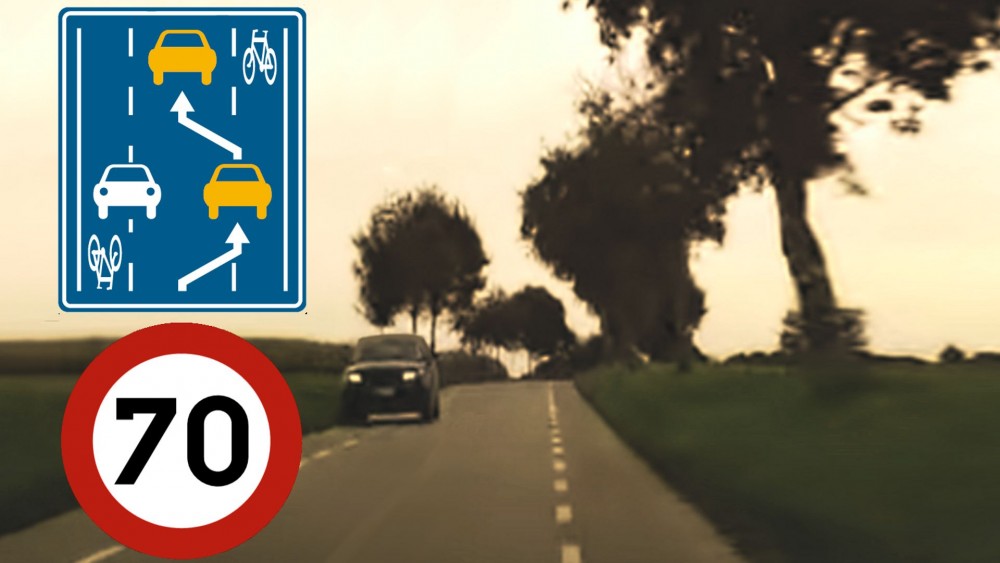
But that's no longer the case: in Wallonia specifically, you'll now have to drive at a maximum of 70 km/h on center-lane roads, a concept that came into being in 2022. Perhaps it's worth re-explaining what this is.
It's a type of road with a central strip for motorized traffic, bordered by two discontinuous parallel white lines on either side of the carriageway.of the carriageway, each consisting of two pairs of short lines, which delimit the fictitious edges of the central-lane carriageway (see drawing). This particular type of pavement is only useful on narrow roads, generally outside built-up areas, with little traffic, and where there is no room for cycle lanes in either direction.
Side lanes" are therefore not a cycle track, but neither are they part of the roadway. They are intended for pedestrians, cyclists, horse riders and Class A moped riders. Drivers of motorized vehicles must stay in the central lane. However, they can use the side lanes to pass another vehicle or to overtake. Provided, of course, that they do not hinder or endanger other road users. Beware, however, that overtaking on this type of carriageway should be avoided in most cases, since, as we've said, these are generally rather narrow roads.
Source: www.rtbf.be/article/