Vietnam: When Australian Families Choose Vietnam for a Different Kind of Education
Faced with the high cost of living and the pressures of daily life, some Australian families are trying out a new way of raising their children. “Worldschooling,” which is based on experiential learning, is leading them to places like Vietnam, where they find a more affordable lifestyle.
For many Australian parents, between mortgage payments, long workdays, and daily commutes related to their children’s schooling, the pace of life is becoming difficult to keep up with. With the rising cost of living and the growth of remote work, some families are choosing to break away from their routines and turn their travels into an extension of their children’s education.
This approach, known as “worldschooling,” involves using experiences in different countries as learning opportunities. Vietnam is among the destinations chosen by Australian families who want to offer their children a different educational environment while keeping costs under control.
Vietnam: A New Family Destination
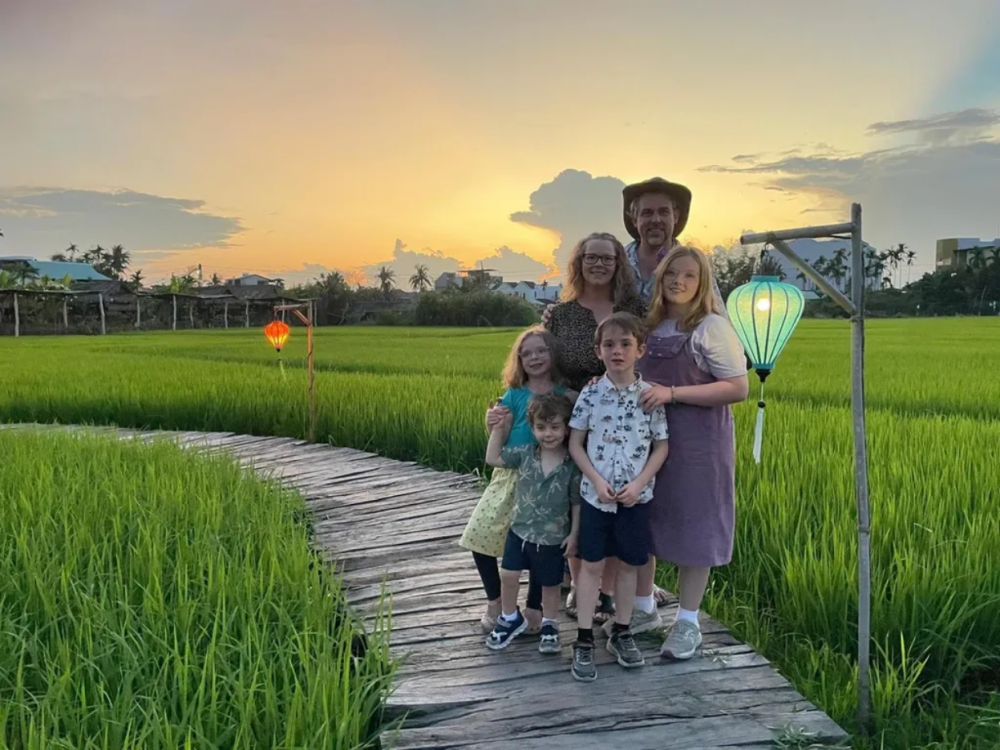
The Mumford family, originally from Adelaide, exemplifies this trend. More than two years ago, Brad and Nicky Mumford decided to radically change their lifestyle. After initially traveling around Australia, they chose to continue their adventure abroad and try worldschooling with their children.
Previously, Brad held a particularly demanding executive position with long workdays. Nicky, for her part, cared for their four young children—including a baby—while hosting international students in their home to supplement the family’s income.
“At work, everyone expected the best from me, but my family had to put up with the worst of me,” explains Brad, noting that their daily life had gradually become “monotonous and repetitive.”
The family first took a sabbatical to travel across Australia in a camper van. Originally planned for twelve months, the trip ultimately lasted 18 months. This experience then led them to consider moving abroad.
Today, the Mumfords live in Central Vietnam. The family also plans to visit South Korea and Japan soon.
For them, traveling is not an interruption of their children’s education, but another way of learning. This allows the children to discover the history of the Vietnam War firsthand, while developing practical skills through everyday activities.
In particular, their 9-year-old daughter had the opportunity to plan and coordinate a series of activities for mothers and babies in their community. According to her parents, this experience helps her develop independence and a sense of responsibility.
The Cost of Living Plays a Major Role in Their Decision
Vietnam’s appeal also stems from its cost of living, a particularly important factor for a large family. The Mumfords estimate that with their current annual income of 60,000 Australian dollars, they would struggle to make ends meet in Australia. In Vietnam, however, they enjoy a standard of living they consider comfortable.
The family currently rents a six-bedroom, seven-bathroom house in Central Vietnam for about 250 Australian dollars a week. When electricity, household expenses, and housekeeping services are added, the weekly cost comes to about 350 Australian dollars. Meals are also a relatively small expense. According to Brad, the whole family can enjoy a hearty meal for less than 20 Australian dollars.
Beyond the financial aspect, this experience fulfills a desire to spend more time as a family and to provide the children with an education more directly connected to their environment.
A Trend That Extends Beyond Vietnam
The Mumfords’ journey is part of a broader trend. According to estimates cited by Nine.com.au, approximately 40 million people worldwide are now embracing the “digital nomad” lifestyle. Long associated with independent workers traveling alone, this lifestyle now also includes some families.
In the wake of the pandemic, some of these families have taken advantage of the widespread adoption of remote work to rethink how they organize family and school life. In Australia, several families are turning to homeschooling by registering with their state’s Department of Education and submitting a structured learning program that aligns with academic standards.
Others, like the Mumfords, request an annual exemption from school attendance while keeping their children enrolled in an Australian school.
The couple has also started their own travel company, specializing in organizing group trips for families interested in worldschooling.
However, Brad emphasizes that living abroad does not eliminate family responsibilities.“Life here is exactly the same as back home, just in a different country,” he observes.
The Mumfords’ experience thus shows that their choice of Vietnam is based on several combined factors: cost of living, opportunities for flexible work, cultural discovery, and a desire to turn everyday experiences into learning opportunities. For these Australian families, Vietnam has thus become not only a place to live, but also an open-air classroom.
Source: lecourrier.vn/