Burkina Faso/Samendeni: AGRODIA and Its Partners at the Forefront of Agricultural Innovation for Food Sovereignty
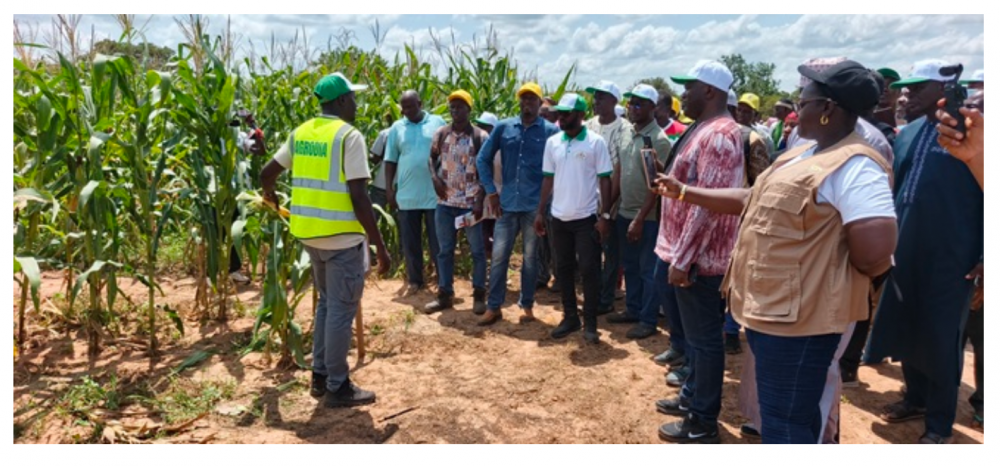
The Association of Agricultural Input Wholesalers and Retailers of Burkina Faso (AGRODIA) organized a guided tour of the Agricultural Technology Transfer Center (CTTA) on Thursday, September 17, 2026, in Samendeni. This initiative, carried out in collaboration with the Soil Values program and the Burkina Phosphate Mining Company (SEPB), aimed to promote good agricultural practices, high-yield seeds, and specific fertilizer formulations to strengthen farmers’ resilience.
Burkina Faso, like other countries in the Sahel, faces numerous challenges linked, on the one hand, to the effects of climate change (recurring droughts, progressive desertification, etc.) and, on the other hand, the limited technical expertise of farmers, who struggle to adopt appropriate and resilient agricultural practices. These factors have a negative impact on soil fertility and thus limit agricultural productivity and livelihoods, particularly for smallholder farmers.
Thus, as part of its activities for the year 2026, the Soil Values program has partnered with AGRODIA to establish demonstration plots at three Agricultural Technology Transfer Centers (CTTA) in Samendeni, Boromo, and Yako during the current 2026–2027 rainy season. The goal of these demonstration plots is to promote and encourage the adoption of sustainable agricultural practices, improve knowledge of and adoption of high-performing and appropriate agricultural inputs (seeds and fertilizers) to contribute to sustainable soil management while improving agricultural yields and the resilience of smallholder farmers in the three watersheds: the Kou, Lower Mouhoun, and Nakambé watersheds.
It was on lush and promising demonstration plots that AGRODIA and its technical and institutional partners gathered this Thursday morning in Samendeni, in the hydro-agricultural district of Houet Province. The goal of this field day was to introduce innovative agricultural technologies to farmers in order to sustainably increase yields and contribute to national food self-sufficiency.
A Synergy of Actions for Sustainable Soil Management
For Adama Ouédraogo, president of the Association of Agricultural Input Wholesalers and Retailers (AGRODIA), this visit is part of a strategic partnership bringing together various stakeholders in the agricultural value chain. “This morning’s visit was organized in collaboration with our partner Soil Values, a program focused on sustainable soil management, and SEPB, the Burkina Phosphate Mining Company,” he explained.
The key challenge lies in promoting suitable inputs and environmentally friendly techniques. “We organized this guided tour to promote best agricultural practices, particularly the use of high-yielding seeds and specific fertilizers, especially for corn. It is also about promoting organic-mineral fertilization for the sustainable management of our land,” emphasized the president of AGRODIA. Observing the state of development of the demonstration plots, he expressed satisfaction with the work accomplished. “Judging by the appearance of the fields, we have clearly achieved our goal. The combination of different practices shows that if producers succeed in replicating these techniques on their own farms, yields and productivity will be significantly higher,” he noted. He reiterated that this initiative is directly aligned with the directives of the country’s highest authorities regarding food security and sovereignty.
Technical Expertise at the Service of Farmers
Guided by Alidou Ouédraogo, a senior agricultural technician at AGRODIA, visitors were able to explore in detail the diversity of crops being tested at the center. Faced with the challenges posed by climate change and declining soil fertility, the choice of inputs and crop varieties is crucial. “In this context of climate variability, where rains are becoming scarce and the soil is becoming depleted, it is imperative to adopt new practices,” the technician recommended, adding: “We have introduced a total of ten hybrid corn varieties with high yield potential, four varieties of cowpea, two varieties of sorghum, and one variety of foxtail millet.”
Particular emphasis was placed on the complementary nature of organic matter and mineral fertilizers. “As the soil becomes depleted, we must nourish it with organic manure combined with the maize-specific fertilizer developed with the SEPB. This helps restore long-term fertility,” explained Alidou Ouédraogo. He also sought to reassure farmers about the feasibility of these approaches: “These aren’t some kind of magic tricks. They’re accessible to all our producers. Everyone, depending on their means, can adapt these best practices for soil management and input use to their own fields.”
Institutional Support and Yield Prospects
Representing the government at the gathering, Mamadou Traoré, the provincial director of agriculture for Houet Province, praised the quality of the work observed on site. He emphasized the effectiveness of the local solutions tested during the growing season. “The condition of the fields this morning is very satisfactory,” he stated.
“The maize-specific fertilizer manufactured by SEPB is proving its effectiveness. What we’re seeing is that, even with doses lower than the formulations typically used by farmers, the results on these plots are remarkable. It’s a very cost-effective alternative.” Turning to the issue of seeds, the provincial director reiterated the importance of adopting certified varieties to reach the next level of production. “Current government policy actively promotes high-yielding varieties. Here, we’re seeing yields ranging from 6.5 metric tons to over 12 metric tons per hectare. With the combined support of research, the SEPB, and distributors like AGRODIA, we are confident that the widespread adoption of these technologies will enable Burkina Faso to achieve food sovereignty.”
At the end of this day of visits and discussions, all stakeholders agreed on the need to expand these demonstration plots throughout the region so that every farmer can experience firsthand the realities of modern, sustainable, and high-performing agriculture.
Source: lefaso.net/