Burkina Faso/Women’s Empowerment and Digital Finance: Orange Money at the Heart of a Silent Revolution
Sometimes all it takes is a simple cell phone to break down barriers that were once thought insurmountable. In the markets, neighborhood restaurants, kiosks, and fruit stands of Ouagadougou, a quiet revolution is underway. It makes no noise, but it is profoundly transforming the daily lives of thousands of women. This revolution is called financial inclusion. For a long time, running a business meant keeping the day’s takings in a scrap of fabric or a flimsy wallet, scrambling for change, crossing town to pay a supplier, or even turning down a sale because of a lack of change. Today, a simple Orange Money payment is all it takes to secure income, pay a business partner remotely, or grow a business without ever leaving one’s shop. Beyond the technology, a new form of economic freedom is gradually taking hold.
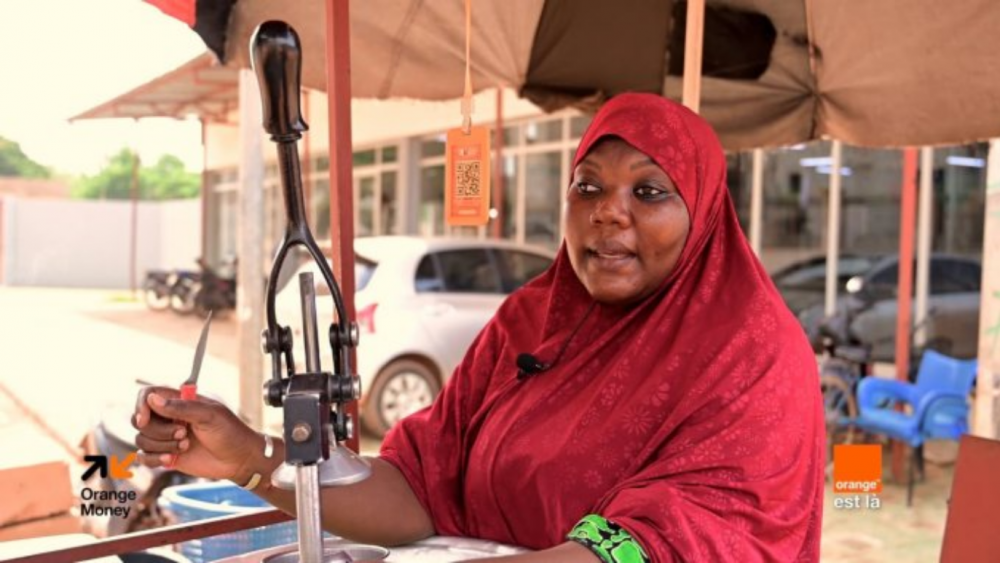
In many towns across Burkina Faso, women are increasingly using electronic transactions to grow their businesses. Whether they own restaurants or sell vegetables, fruit, juice, cakes, and more, many women in Ouagadougou—in particular—are turning to Orange Money as a reliable partner to safeguard their cash on hand and prevent loss of income.
It is 1:00 p.m. on Friday, July 31, 2026, at “Restaurant chez Tantie propre,” located just a stone’s throw from the Ouagadougou Central Police Station. Lunchtime is in full swing. Plates of attiéké with fish, tô, and rich rice are being served one after another, and customers are coming and going. Among them is Alima Ouédraogo, a young street vendor, who is finishing her meal. When it’s time to pay, no bills come out of her bag—her phone is all she needs. A few seconds later, the Orange Money payment transaction is confirmed. The gesture seems mundane. But for Assita Touré, the restaurant’s owner, it symbolizes a major change she has been actively driving through her trust in Orange Money since 2024: “Coins have become scarce—even paper bills. It’s not easy at all. Imagine a customer who buys 1,000 CFA francs and gives you 10,000 CFA francs. Not only does the time spent looking for change hold up other customers, but—worse still—there’s a high chance we won’t find any. That’s why we give customers the option to pay their bill via Orange Money,” she explains. She quickly realized that this simplicity benefits both her business and her customers. She now encourages those who don’t yet have an account to take the plunge for the ease of transactions and the simplicity of fast, secure, instant payments.
“When they come in and tell me they don’t have an e-money account or prefer cash, I reassure them that with electronic transactions—especially Orange Money—those worries are a thing of the past. Many of my customers came to thank me after opening an account,” she says happily. For her, Orange Money is no longer just a payment method—it’s a tool that makes life easier. A few kilometers away, in front of the Faso Mêbo headquarters, Segdi Lompo, a cake seller, no longer turns customers away for lack of change.
The cash register becomes a secure account
She has an Orange Money business account to attract customers who prefer to save time while out and about. It was 4:10 p.m. when we arrived; Ms. Lompo stood up to carefully arrange her goods in stacks of five (05). The prices are 100F and 250F. Clearly, her Orange Money business card is attached. All smiles, she explains that with the Orange Money account, she’s able to keep track of her cash flow.
“Before, I was losing customers because of cash. Now my cash register is my Orange Money account. I no longer have to run around looking for change; I have better control over my revenue, and my customers are satisfied,” she says. This statement alone sums up one of the major transformations brought about by digital finance. The day’s revenue is no longer at risk of theft or loss; it’s secure. For thousands of female business owners, this change represents much more than mere convenience. It’s a real driver of financial independence that changes lives.
For Nelly Kondé, wife of Sombié, Secretary General of Orange Money Burkina Faso, financial inclusion goes far beyond the issue of digital payments. “Managing income isn’t just about receiving it. It means being able to keep it safe, transfer it instantly, make it grow, and freely decide how to use it. It is this financial autonomy—often subtle but profoundly transformative—that we are placing in the hands of Burkinabé women,” she says. She identifies three major benefits. The first is security: female merchants are no longer forced to carry their daily takings, exposing them to the risk of theft or loss. The second is traceability: every transaction leaves a record, allowing for better tracking of income and expenses.
The third is accessibility: a merchant based in Koudougou can now pay her supplier in Ouagadougou without leaving her market stall.
Another key point is that the CEO of Orange Money Burkina Faso has expressed her conviction that “no Burkinabé woman, wherever she may be, regardless of her level of education or occupation, should feel excluded from the digital payments revolution.” This means extending the Orange network to even the most remote villages, designing products that truly cater to women’s needs, and making financial education an ongoing effort rather than a one-time campaign.”
A Gateway to Other Financial Services
For Nelly SOMBIE, the Orange Money account serves as a gateway to other financial services that were previously inaccessible to a segment of the population: “The deepest ambition of electronic money is to be a first step toward a comprehensive financial ecosystem. An Orange Money account, funded and used regularly, builds a transaction history that becomes a financial identity for women who, until recently, didn’t even exist in the eyes of any banking institution.”
This identity gradually paves the way toward formal savings, microcredit products tailored to women’s often short or seasonal work cycles, and, in the future, accessible insurance solutions designed to protect informal work from unforeseen events. For her, “This is precisely where Orange Money Burkina Faso’s deepest ambition lies. We are moving forward on this path by building partnerships with financial institutions and microfinance actors, convinced that no single operator can achieve full financial inclusion on its own: it is built by many hands, like a community granary.”
The Promise of Interoperability
For Orange Money, interoperability is the promise that a woman’s money will no longer be confined to a single channel. Today, a user may encounter invisible barriers between her mobile account and her provider’s bank account, between her operator and that of her client in another region, or even in a neighboring country.
Every bridge built between these systems—particularly with banks and other microfinance actors—means one fewer barrier for a women entrepreneur whose business knows no such compartmentalization. This is a challenge that the BCEAO has recognized, and one that we champion with conviction, particularly through the regional initiatives of the interoperable payment systems platform in the UEMOA Zone led by the Central Bank of West African States, because an economy that seeks to fully include its women cannot afford to fragment itself into systems that do not communicate with one another.
Building Women’s Trust
This inclusion also depends on trust, which is the cornerstone of any financial service. Orange Money Burkina Faso is continually strengthening its security measures to better protect female users from scam attempts. Awareness messages broadcast in national languages, systems for detecting suspicious transactions, simplified reporting procedures, and the prohibition on using one’s date of birth as a PIN—all these measures aim to make the service even more secure.
Initiatives that address very real situations
Assita TOURE, owner of the restaurant “Tantie Propre,” admits to having been the victim of a dishonest customer who claimed to have made a payment that never actually appeared in her account. Since then, she has systematically verified every transaction. This vigilance complements the protective measures put in place by Orange Money Burkina Faso.
When illiteracy ceases to be a barrier
One of the greatest achievements of this transformation is undoubtedly this: it leaves no one behind. Outside the Burkina Faso News Agency, Aminata OUEDRAOGO sells fruit. Since the beginning of 2025, she has been using an Orange Money business account. On the evening of July 31, around 5 p.m., people are hurrying home. Some stop to buy oranges from Ms. Ouédraogo. To avoid the hassle of handling cash, Salif Kientega, a passerby, uses electronic payment through the vendor’s Orange Money business account. “I’m in a hurry because it looks like it’s going to rain. I prefer instant payments rather than making the lady run around looking for change she isn’t sure she has. I have an Orange Money account, and with hers, it’s a done deal. It’s simple, reliable, and fast,” he says. Ms. OUEDRAOGO experiences the reality of financial inclusion firsthand with Orange Money: “Even though I’m not educated, I use an Orange Money business account to satisfy my customers.”
This single sentence sums up the ambition behind Orange Money Burkina Faso. Because financial inclusion cannot be reserved solely for educated people, the company is investing in community-based financial education. In many cases, illiterate women are breaking down barriers and showing increasing interest in instant payments. To improve their financial and digital literacy and enable them to use these services safely, Orange Money Burkina Faso has taken the bull by the horns. For the Secretary General, financial education is the very foundation of sustainable inclusion. At the Commercial and Administrative Activities Zone, Mariam ILBOUDO sells juices. On her cooler, an Orange Money QR code allows customers to pay for their purchases instantly. “Since I’ve been using Orange Money, I’ve never had any issues with transactions. I can only thank the operator for the trust it places in its customers and for the various measures taken to ensure the reliability and security of transactions,” she exclaims.
In the same vein, she believes that if instant payments didn’t exist, they would definitely need to be created. That’s why she encourages other women who are hesitant to take the plunge to reach out to the managers at Orange Money Burkina Faso. Her story echoes those of Assita, Segdi, Aminata, and thousands of other women.
Ultimately, they all tell the same story: one of a business that has become simpler, a more secure income, a more dynamic trade, and a woman who gains a little more independence every day. In Burkina Faso, financial inclusion is no longer just an aspiration. It is a reality of daily life—in markets, restaurants, newsstands, neighborhood stores, and even in the most remote villages.
As a major player in digital finance and the only Electronic Money Institution authorized by the Central Bank of West African States in Burkina Faso, Orange Money Burkina Faso is pursuing this goal: ensuring that no woman is left out of the digital financial services revolution.
Source: lefaso.net/