
Belgium/Spiennes and the Silex’s: Beneath the Fields of Hainaut, the Genius of the Neolithic Era
During the Neolithic period, somewhere in what would later become Hainaut, people were digging. With their bare hands—or almost. Without metal, without dynamite, without machinery. Just flint picks, animal shoulder blades used as shovels, and woven baskets to haul out the excavated material. They descended into vertical shafts, in total darkness, with grease lamps. And they were searching for flint, the essential raw material for making their tools. Incredible? Indeed. Six thousand years ago, beneath the fields of Spiennes, six kilometers from Mons, one of Europe’s largest and oldest flint mines was in operation. 2,000 years of mining. 150 hectares of underground space excavated, turned over, and transformed. And today, you can explore it all. Discover it on *L’Agence Tourisme* on RTBF La Première, with support from VisitWallonia.
The Spiennes site has been listed on the UNESCO World Heritage List since the year 2000. In 2025, it celebrated the 25th anniversary of its inscription. The recognition highlights what is known as human ingenuity: the ability of these Neolithic people to invent extraction and cutting techniques that were absolutely astonishing for their time. Vertical shafts descending to depths of up to sixteen meters. Horizontal tunnels branching out in all directions to follow the flint veins. A dizzying underground network, designed and mined without plans, without engineers, and without hard hats.
And the site is colossal: 100 hectares. It was mined for nearly 2,000 years, between 4350 and 2300 BCE. Flint tools from Spiennes have been found more than 140 kilometers from the mines, evidence of a prehistoric trade network that was already well-organized. Spiennes was already, 6,000 years ago, an export hub.
What excavations have revealed at this UNESCO World Heritage Site
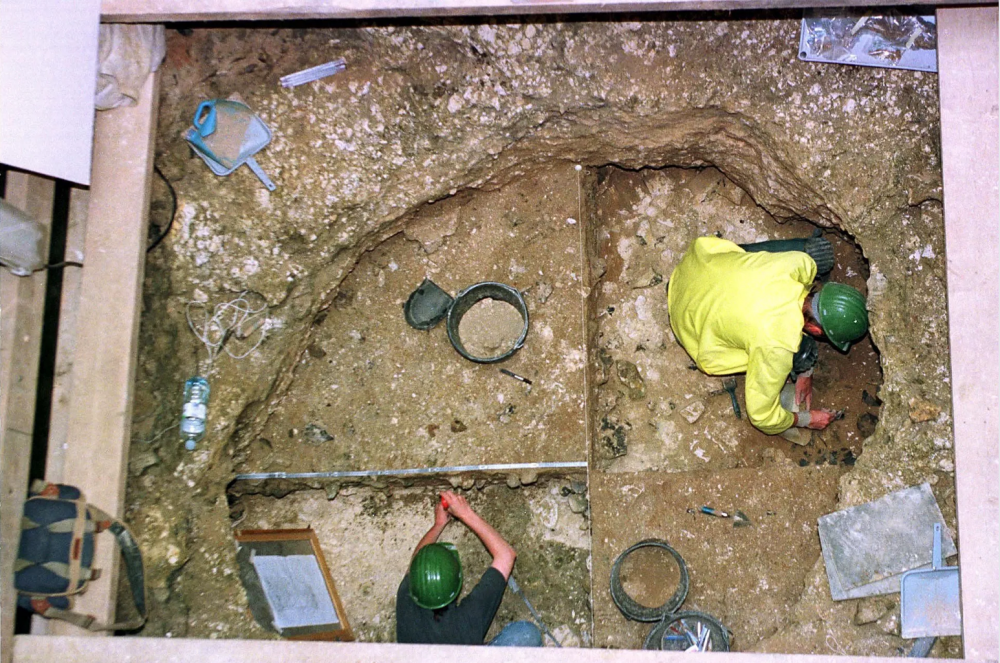
Excavations are still ongoing at the site today. And each excavation campaign yields new artifacts that enrich our understanding of these prehistoric societies. What’s staggering is that, of these 100 hectares, only 500 square meters have been excavated so far. So we still know almost nothing about what lies buried beneath these fields.
Among the discoveries already made, one stands out in particular: the skeleton of an adult woman, carbon-14 dated to between 3360 and 3030 BCE. She had been there, right beneath our feet, for more than 5,000 years. And her presence deep within the mine reveals something important: this was not solely a man’s world. Women also ventured down into the mine.
The Silex’s: The Interpretation Center
To discover all this, there’s the Silex’s, the interpretation center located at the site’s entrance. An interactive exhibition traces the history of the Spiennes quarries, the mining techniques, and the lives of Neolithic people. There are reenactments, authentic artifacts, and clear explanations accessible to all ages. You can then take a stroll around the outdoor site, walk above the shafts, and get a sense of what it’s like to be where it all began. And the highlight of the visit takes place ten meters underground, accompanied by a guide. You put on a safety suit, grab hold of the vertical ladder, and climb down. Into the darkness, the dampness, and the silence.