
Senegal/Kafountine: Women Who Smoke Fish—A Resilient Mainstay of a Fisheries Sector Seeking Modernization
At the fishing pier in Kafountine, a town located in the northwest of the Bignona department (south), dozens of women carry on—amid the heat, smoke, and fishy odors—a trade that is as grueling as it is essential to the local fishing economy: smoking fish. Thanks to expertise passed down from generation to generation, they derive most of their income from artisanal fish processing, even as they expose themselves to health risks on a daily basis.
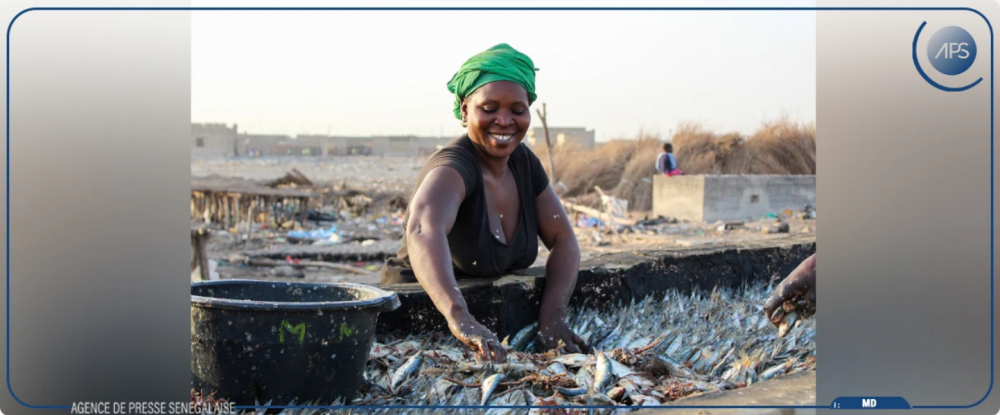
A stifling heat weighs down on the Kafountine fishing pier on this mid-afternoon in July. Steam laden with the scent of fish fills the air. In the distance, columns of smoke rise, slow and thick, above a tangle of makeshift tents.
To reach the workplace of these brave women, one must wade through blackish streams, sometimes endure a foul stench, and navigate around basins and fish waste.
Here, the women who smoke fish are a discreet yet essential link in the seafood processing chain, which sustains a whole sector of Casamance’s fishing economy.
Under a sun that shows no sign of letting up, they bustle about, dripping with sweat, working with great enthusiasm.
Amid makeshift shelters stands a modern structure: a zinc roof supported by columns, housing twenty-four rectangular ovens lined up in a row, each topped by a metal chimney from which smoke rises.
Seated directly on the ground, on mud-brick benches, or on large empty drums, these women—who have come together as an Economic Interest Group (GIE)—wait. The smoking process won’t begin until 5:00 p.m., after the gutted and salted fish have had time to dry in the sun.
But already, a few ovens lit the day before are releasing wisps of smoke that, in bursts, fill the air and sting the eyes.
“This work brings us joy”
Her face marked by age and the rigors of the trade, Amélie Diédhiou, secretary of the GIE, recounts the story in Wolof, her voice bearing the distinctive mark of the Diola Karone accent. The GIE, which has sixty-six women members, was formed in 1995 through the merger of three groups, she explains.
“Some are elderly and no longer come, but they sometimes send their children in their place,” she adds.
In 2016, UN Women and the World Food Programme (WFP) equipped the site with these modern ovens. The women welcome this progress, though not without feeling a sense of disappointment regarding government projects that remain unfinished.
The GIE also occasionally hosts schoolchildren and students from Bignona who come to learn how to smoke fish.
This work is carried out like a ritual. After the 5:00 p.m. prayer, a group of women fill basins with dried fish, then pour them onto the wire racks placed above the ovens, while others arrange them vertically with almost artistic care.
Everything takes place in a relaxed atmosphere, filled with conversation and songs in Diola Karone.
A swarm of flies immediately descends on the fish with their gleaming scales. Siré Diabang, with fair skin darkened by the sun and smoke, is among the women who deftly arrange the fish on the wire racks.
This woman in her fifties, vice president of the GIE, has, in a sense, inherited the trade from her mother. With what she earns, she covers her children’s school fees and provides for her family’s needs. The same is true for the other members of the GIE. Siré Diabang says this with pride, as a stinging rebuke to all those who consider this work demeaning and refuse to do it.
Health Risks
A few young women tried their hand at it before giving up, put off by the fish’s lingering smell. “Our happiness is rooted in this work. Even if the smell follows us all the way to bed, we’re happy with it. I don’t bother anyone. I don’t beg. I don’t engage in any dishonorable activities,” says the woman who, as a child, used to accompany her mother to the same spot.
“This is the only work I know, besides a little poultry farming,” says Siri Diabang.
In addition to their cooperative work within the GIE, each member has also set up her own business. “Everything is going very well,” assures Amélie, the GIE’s secretary, noting that “the profits we’ve made have never been a source of problems” among them. As the saying so aptly puts it, “Good accounts make good friends.”
Once the fish are smoked, Omar, a young man of Guinean origin, arrives to take charge of supplying the families and preparing the ovens for the next smoking session.
“The largest batch of smoked fish is sold in Guinea-Bissau. People in Guinea-Bissau love smoked fish,” explains Siré Diabang.
Smoking fish is not without health risks. “The smoke that escapes stings the eyes,” says Mariama, tears streaming down her cheeks as she stokes the flames.
According to her, this work causes recurring colds, migraines, and lung conditions.
Like her, the other members of the GIE also lament the lack of sanitation, stagnant rainwater, and the absence of lighting at their workplace.
At the Kafountine fishing pier, twilight heralds the onset of night. The breeze blows from the ocean toward the village homes, bringing a bit of cool relief to the residents. A day of hard work comes to an end, giving way to a moment of respite and a meal. On the menu: the ever-present “niankatang,” a dish of white rice beloved by the Diola people, served with a sauce of their choice. Yet the ovens continue to burn, a reminder of the next day’s routine of smoking fish.
Source: aps.sn/