
Benin/Improving Agricultural Productivity in Benin: The Food Systems Project Aims to Provide a Sustainable Solution to Land Degradation
The majority of agricultural soils in Benin are becoming increasingly depleted, leading to low agricultural productivity. The project “Sustainable Food Systems for Greater Resilience and Food and Nutritional Security in Benin,” which the Minister of Agriculture, Livestock, and Fisheries officially launched on Friday, July 24, 2026, at the Benin Royal Hotel in Cotonou, is designed to provide a sustainable solution to this scourge that is undermining Benin’s agriculture.
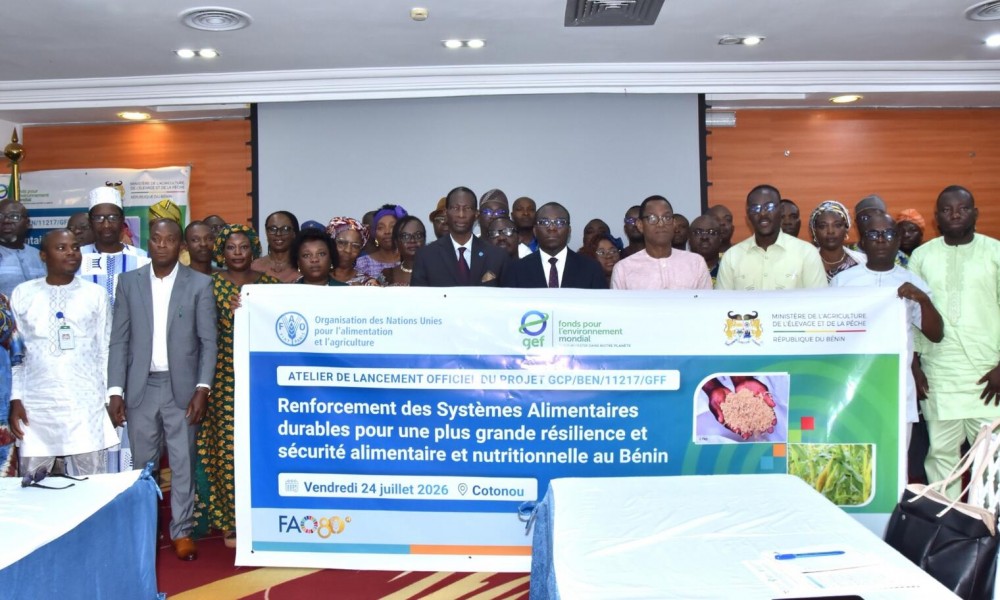
Poor soil leads to low agricultural yields, creating a vicious cycle of precariousness for farmers, explained the Minister of Agriculture, Livestock, and Fisheries, Mr. Adin Yeton BLOUKOUNON GOUBALAN, at the project’s launch. In Benin, a 2019 survey revealed that more than 5 million people—about 40% of the national population—were exposed to land degradation, and nearly 38% of the total land area was classified as degraded. This degradation severely affects people’s livelihoods, depriving them of access to essential ecosystem services such as food and water, thereby increasing the risk of poverty. The Minister added that soil degradation reduces agricultural yields in Benin by at least 50%.
This is an urgent matter. This is because agriculture is one of the main pillars of Benin’s economy. On average, it accounts for 26% of the gross domestic product, nearly 80% of export revenues, and generates approximately 70% of jobs. Corn and rice are the two main staple crops consumed in Benin, in both rural and urban areas. These findings have led the Government of Benin, with support from the Food and Agriculture Organization of the United Nations (FAO) and the Global Environment Facility (GEF), to develop the project “Sustainable Food Systems for Greater Resilience and Food and Nutritional Security in Benin.”
Also known as “Food Systems,” this project was designed to improve policies, production, and markets to accelerate the transformation of the rice and maize value chains, moving from low productivity and high environmental externalities to sustainable, integrated, and efficient food systems that generate social, economic, and environmental benefits for Benin.
36,000 targeted producers
The project, which will run through 2030, will restore 20,000 hectares of degraded land, bring 114,900 hectares under sustainable best practices, and benefit 36,000 direct beneficiaries and 356,000 ultimate beneficiaries in the municipalities of Karimama, Malanville, Glazoué, Kétou, and the Aguégués. Its total cost is $20,766,207, with a contribution of $5,966,207 from the Global Environment Facility and co-financing of $14,800,000 as Benin’s counterpart contribution.
Given the project’s significance, Minister Adin Yeton BLOUKOUNON GOUBALAN urged caution regarding the technologies to be used for soil restoration before their implementation.
Mr. Paul-Henri Zoéwindé BOUDA, FAO Resident Representative in Benin, emphasized that the project’s success will depend on the collective commitment of all stakeholders, all organizations involved in its implementation, and the beneficiaries.
Source: www.gouv.bj/article