
China/Francophone Participation in the Wuhan Summer School on Digitized Cultural Heritage
From July 1 to 6, 2026, Wuhan University organized an international summer school on the digital preservation of cultural heritage, bringing together 31 participants, including three faculty members and five Vietnamese students from AUF member universities, the latter having been selected through a Francophone call for applications supported by Wuhan University.
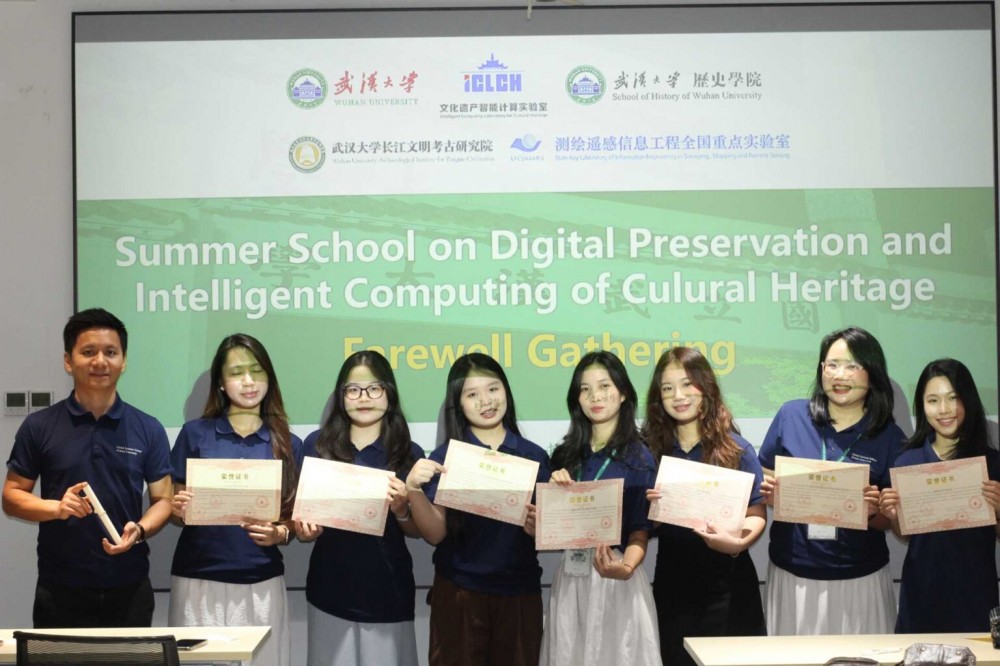
The event, titled “Systematic Preservation and Interactive Narration of Cultural Heritage Driven by Digital Intelligence,” was jointly organized by the Intelligent Computing Laboratory for Cultural Heritage, the School of History, the Institute of Yangtze Civilization Archaeology, and the National Key Laboratory of Information Engineering in Cartography and Remote Sensing, all affiliated with Wuhan University.
Thirty-one trainees from the United States, Thailand, Vietnam, Cambodia, and Myanmar took part, as part of a Francophone call for applications launched by the AUF Asia-Pacific, with specific support from Wuhan University for hosting these participants. The program was organized around three components: theoretical courses, practical workshops, and field visits, covering the digitization of cultural property, heritage promotion, UNESCO’s development guidelines, and cultural visualization.
A Francophone track at the heart of the summer school
Among the participants, three Vietnamese faculty members and five students from AUF member universities took an active part in the activities and discussions. Nguyễn Đoàn Linh Châu, from the Vietnam University of Foreign Trade, praised the visit to the Intelligent Computing Laboratory for Cultural Heritage at Wuhan University, describing it as a memorable experience: there she discovered several research projects and was able to observe firsthand the use of advanced technologies to address practical problems—a visit that fueled her interest in research and innovation.
During the visit to the Panlongcheng archaeological site, Dr. Lê Duy Thanh, a faculty member in the Department of History and Architectural Conservation at Hanoi University of Architecture, highlighted the relevance of the site’s spatial museum design as well as the significance of the digital restoration of ancient structures. Dr. Nguyễn Ngọc Phương Hồng, a professor in the Faculty of Law at the University of Economics and Law, Vietnam National University, Ho Chi Minh City, noted that 3D modeling, augmented reality, and video used at the Panlongcheng Museum make ancient civilizations tangible for diverse audiences, giving cultural heritage a contemporary vitality and renewed educational value.
During a visit to the Hubei Provincial Museum, Vietnamese intern Nguyễn Phương Anh, along with her Thai and American counterparts, expressed great enthusiasm for the Bianzhong bell set of Marquis Yi of Zeng, which has been preserved for over two millennia and is still capable of producing melodious sounds.
A Three-Pronged Educational Program
On the theoretical front, the interns attended lectures focusing in particular on the visual and narrative reconstruction of ancient Chinese murals, the digital preservation of Ming and Qing dynasty archives, the role of culture in sustainable development according to UNESCO, and methods for the intelligent design of cultural visualization.
The practical component allowed trainees to learn methods for the digital preservation of movable cultural heritage, the processing of aerial survey data collected by drones, and three-dimensional modeling, with hands-on practice using dedicated software platforms.
Field visits took the trainees to the Intelligent Computing Laboratory for Cultural Heritage at Wuhan University, the Panlongcheng archaeological site, the Hubei Provincial Museum, and a local technology company specializing in 3D reconstruction using satellite, aerial, and laser telemetry data.
The closing ceremony, held on July 6, featured the presentation of certificates of completion and a speech by Wuhan University, commending the trainees’ achievements and encouraging them to continue exploring the systematic preservation and interactive storytelling of cultural heritage driven by digital intelligence.
AUF Asia-Pacific would like to commend the excellent cooperation with Wuhan University, an associate member of the Agence universitaire de la Francophonie, as well as with its Intelligent Computing Laboratory for Cultural Heritage, which regularly organizes Francophone initiatives in the field of digital heritage.
Source: www.auf.org/