
Vietnam is banking on STEM talent to accelerate its technological growth
Vietnam is currently focusing on a strategy to develop high-quality human resources in the STEM fields (science, technology, engineering, and mathematics). The goal is to train a skilled workforce in key fields, enabling the country to make rapid progress in cutting-edge technologies, particularly semiconductors and quantum technologies.
According to Associate Professor Dr. Phan Thanh Binh, former chair of the National Assembly’s Committee on Culture, Education, Youth, Adolescents, and Children, the Fourth Industrial Revolution is driven by strategic technologies such as artificial intelligence, semiconductors, advanced biotechnologies, new materials, new energy sources, quantum technologies, and next-generation digital technologies.
In a sense, these strategic technologies represent a higher-level evolution of the four key technology sectors identified by Vietnam more than 20 years ago: information technology, biotechnology, materials science, and mechanical engineering and automation.
Information technology has thus evolved toward artificial intelligence (AI), big data, cloud computing, and quantum technologies; mechanical engineering and automation have transformed into robotics and smart manufacturing; materials technology has expanded to include advanced materials and nanomaterials; and finally, biotechnology has evolved toward genetic and cellular technologies.
Associate Professor Phan Thanh Binh, Ph.D., believes that Vietnam is currently among the countries with a strong capacity to adopt and apply technologies, and that it is gradually moving into the group of innovative nations. However, the main obstacles lie in research capacity, mastery of core technologies, the transfer of research results into production, the quality of the innovation ecosystem, and high-level human resources.
He asserts that to resolve this issue, a shift in mindset is necessary—moving from simply training the workforce to building genuine national capacity. To achieve this, STEM education must be promoted starting in elementary school to foster a scientific mindset in students from an early age.
Furthermore, the education system must be restructured with an emphasis on mathematics, physics, chemistry, and computer science—the indispensable foundations of AI and semiconductors. Human resources must be developed at multiple levels, ranging from technicians to design engineers, researchers, and managers, while building an ecosystem that links the government, schools, and industry—one capable of attracting both domestic and international experts.
Closely Linking Education to Practice
Associate Professor Trân Lê Quân, rector of the University of Natural Sciences (Ho Chi Minh City National University), notes that his institution is implementing a comprehensive strategy ranging from academic programs to the development of infrastructure for emerging technologies.
In addition to its laboratories, research centers, and state-of-the-art equipment in fields such as semiconductors, advanced materials, AI, data science, biotechnology, and quantum technologies, the university is strengthening its cooperation with businesses to develop laboratories closely linked to production. This model gives students access to technologies and a work environment that closely mirror industrial realities, while offering faculty and students more opportunities to conduct applied research that addresses the concrete needs of businesses.
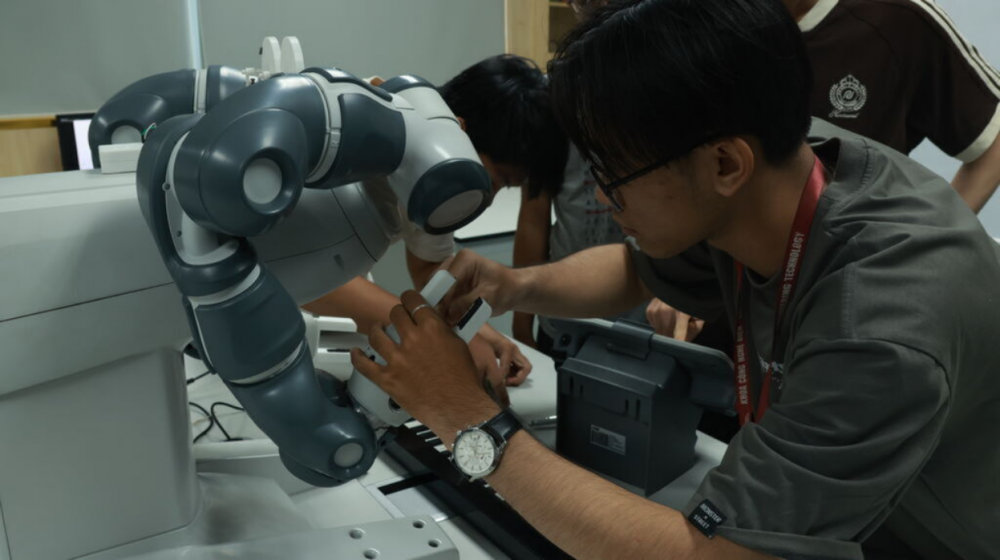
For its part, Ho Chi Minh City University of Technology prioritizes education closely tied to practical application. Students participate in projects, carry out design work, complete internships at companies, and take part in hands-on technological activities. The university is also developing interdisciplinary programs to meet the needs of emerging scientific fields.
To ensure the quality of education, Associate Professor Dr. Bùi Hoài Thang, head of the university’s Office of Education, notes that programs are regularly updated in accordance with international standards.
The university is also strengthening its collaboration with leading technology companies to develop educational content, organize specialized internships and applied projects, thereby offering students early immersion in the professional world and access to the industry’s latest technologies.
The university also places particular emphasis on developing students’ professional skills, their research and innovation capabilities, their ability to thrive in a multicultural environment, their proficiency in foreign languages, and their capacity to adapt to rapidly evolving technologies.
Source: lecourrier.vn/