
Company Tour for 90 Young French-Speaking Entrepreneurs from Cambodia
On June 28, 2026, the Francophone Employability Center (CEF) in Phnom Penh organized a company visit to Kampong Thom for 90 students enrolled in entrepreneurship training programs at several AUF member universities in Cambodia. The trip began with a presentation and preparatory discussions on the bus, as well as the formulation of questions to ask the company.
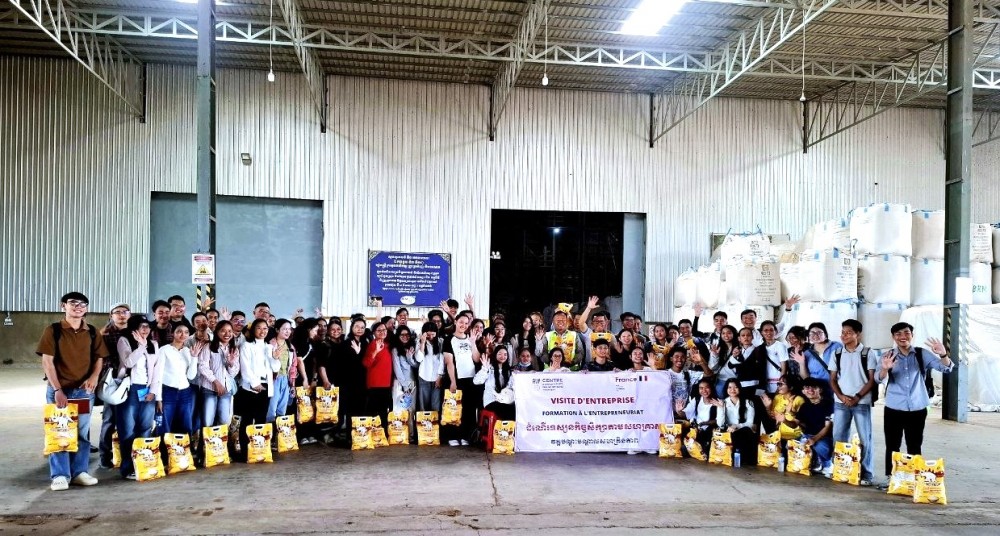
Supported by the French Embassy in Cambodia as part of the Équipe France Fund (FEF), the visit took place at BRM Agro, a rice mill and farm specializing in the production and processing of high-quality rice for export, particularly to the United States and Europe. The company presentation and exchange of experiences began with the story of its founder, Mr. CHAN Ang, a former student at the Royal University of Law and Economics and also a France-Cambodia alumnus. He began his studies in 1993 in the specialized track of the BBA program and completed them in 1998. Thanks to scholarships from the French government, he continued his studies at AIT, then at ESCP-EAP in Paris, and subsequently at Babson College and MIT in Boston, USA, until 1999.
Upon his return to Cambodia, he first worked at the World Bank, then at the American oil company Shell until 2006, before joining ANZ Bank. He worked there for five years, then joined SOKIMEX, a major Cambodian oil company, where he remained for eleven years before starting his own business.
Founded in 2018, BRM Agro is based on a unique model: the company leases rice fields from farmers, builds irrigation systems, and provides them with the necessary inputs—including seeds, fertilizers, and insecticides—while committing to buy their rice back at a guaranteed price.
Mr. Chan Ang, CEO of BRM Agro
“We view farmers as partners. We lease rice paddies to them and provide them with the raw materials. They contribute only their labor. If the harvest is good, they earn more, because we have already guaranteed a price higher than the market rate. So they don’t have to worry when harvest time comes. To date, there are about 750 beneficiary families living in the surrounding area, and we hope to expand our capacity even further,” explained Mr. Chan Ang, CEO of BRM Agro.
According to him, his commitment to agriculture stems from three main reasons: the Royal Government’s policy of exporting one million metric tons of rice, his family’s background in the rice trade in Thmar Kol, Battambang Province, and the small number of Cambodian intellectuals investing in the agricultural sector.
With enthusiasm, the company executive accompanied the students throughout the day, showing them the husking, drying, and sorting machines, the storage areas, the packaging workshops, as well as the farms and infrastructure located away from the rice mill’s premises.
“I am pleased to welcome nearly a hundred young people who asked many interesting questions about the challenges facing the rice industry, particularly production and export. In practice, many difficulties arise. If we have competent people, these problems will be resolved more quickly, because one person alone cannot do everything,” emphasized Mr. CHAN Ang.
When asked why he left a comfortable job in an air-conditioned office in the city to work in the heat alongside farmers, he replied : “It’s because I love working in this field with all my heart. As a Cambodian with a college education, if I don’t do this work, who will do it in our place? This is just the beginning. I want to be a role model for the Khmer people, especially for the younger generations, so that they continue to develop not only agriculture and rice farming but also other sectors.”
The company also offers internships and jobs to young people in various fields: farms, rice mills, technical work, electricity, management, and accounting. However, it remains difficult to find young people willing to work and live on-site, far from the city. The lack of interest among young graduates in rural life remains a recurring problem. Yet, according to the entrepreneur, it is difficult to sustainably support farmers without investing on the ground.
The students also shared their impressions after the visit.
“During today’s visit, I learned a lot from the CEO’s experience. He is very competent and flexible. His business is well-developed, as evidenced by the numerous machines in the rice mill, as well as the technical, commercial, and human resources management,” said Ms. EM Rina, a student at ITC-Kep.
For her part, Ms. HAO Ratha, a student at ITC, believes that entrepreneurship is essential for young people. “An entrepreneur not only helps themselves, but also creates jobs and supports the community,” she said.
According to Mr. CHAN Ang, the company can dry 800 metric tons of rice per day, store 20,000 metric tons, and mill and export 3,000 metric tons monthly. He aims to increase his production capacity tenfold in order to help up to 10,000 families, create more jobs, and develop new infrastructure and irrigation systems in the future.
The students learned about the various stages of rice processing—from drying to husking, including sorting, storage, and packaging—as well as the company’s different departments and warehouses. They then toured the irrigation systems, production farms, agricultural machinery repair shops, and the insecticide production facility.
According to the workshop manager, the company limits the use of purely chemical products and favors traditional insecticides in order to support farmers while meeting the quality standards required by buyers in European and American markets.
Source: www.auf.org/