France/Regional elections 2021 in Normandy: Morin re-elected, the left 2nd, abstention... 5 things to remember
The outgoing president Hervé Morin has been re-elected after the second round of regional elections 2021 in Normandy. A ballot marked by a record abstention that raises questions and by traditional parties that show that at the local level, we must always count on them.
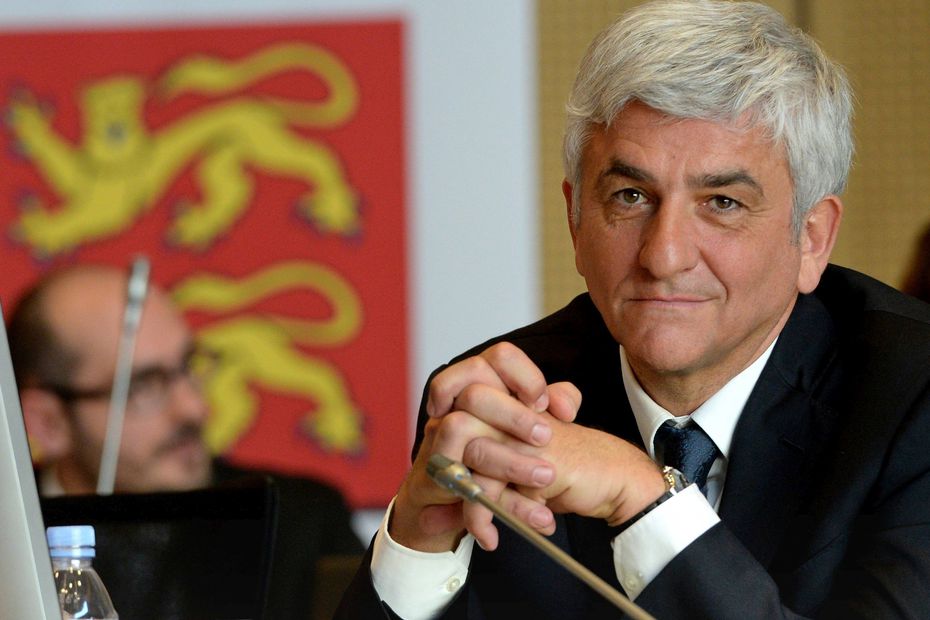
Hervé Morin wins like all the outgoing presidents of the territory, the left is seriously back in the game and the abstention rate is a sad record... what lessons can be drawn from this second round of regional elections in Normandy? We take stock for you.
Hervé Morin re-elected...
The Normans say to me "You have done the job, now continue!
Hervé Morin, outgoing president (Centrist-LR) re-elected as head of the Normandy region
With 44.26% of the votes, theoutgoing president Hervé Morin (Centrist-LR) thus retains the Normandy Region. Behind him, the candidate of the left Mélanie Boulanger (PS/EELV/Gen.s) collects 26.18% of the votes and ahead of Nicolas Bay (RN) with 19.52%and Laurent Bonnaterre (LREM) with 10.04%.
This re-election is for Hervé Morin, outgoing president, "a real satisfaction". And a recognition of the work already done since December 2015. "During the campaign, I heard a lot "You have done the job and you have kept your commitments". This result, which is significantly better than that of 2015, is a result that says "You have done the job, we let you continue to do it".
Hervé Morin was therefore able to count on his record and on the "outgoing candidate bonus" associated with a higher profile than his rivals. He is not an exception, the opposite would have been the case. Thus, all of the territory's outgoing presidents were able to keep their fiefdoms. Hervé Morin declared on our set:
I like this job and I feel good in it. I no longer have any national political perspective, I wanted to devote these next 6 years to my region, so I am happy with the result, it is a nice result.
Hervé Morin, outgoing president (Centrist-LR) re-elected as head of the Normandy region
He added " regretting the major abstention" (see below), " but we had no reserve of votes a priori between the first and second round and we improve our score very largely, it proves that the Normans wanted it to be so."
...for a final mandate
Hervé Morin announced on the set of France 3 Normandy, this mandate at the head of the region, which will last 6 years and 8 months exactly, will be the last of his political career. In March 2028, Hervé Morin will not stand for re-election, and the re-elected president's answer was very clear: his political life "will come to an end at the end of this mandate". Asa reminder, the next regional elections have been postponed to March 2028 in order to avoid too close proximity to the presidential and legislative elections of April-May and June 2027. Hervé Morin will then be 66 years old.
The abstention between distrust and incomprehension, but not only...
Normandy has 2,328,247 registered voters. And only 784,909 voters on this election of June 27, 2021. That is an abstention of 67.09%. More than 2 out of 3 Normans did not go to vote, the operation of mobilization between two rounds did not work. " This is not the fault of the media or the candidates, it proves a real structural defect" analyzes Bruno Cautrès, political scientist Cevipof and consultant France 3 Normandy. Hervé Morin adds "Abstention has hit everyone, not just the RN. It's not just opponents of the majority."
The abstention other big winner of this second round? This is particularly the case among young people. Small reminder: during the first round of these departmental and regional elections 2021, last June 20, 87% of 18-24 years did not go to the polls. The trend was confirmed in this Sunday, June 27. "Young people who for some were not even aware of the holding of these departmental and regional elections", as our journalist in Caen Florent Turpintells us. "Some of them told us that they did not go to vote because they were preparing for their end-of-year exams, because they were not registered to vote.Some of them told us that they did not go to vote because they were preparing for their final exams, because they were not registered to vote or simply because they were not interested in the candidates or in politics in general.Anexplanation for this historic abstention, even if some of them also promised that next year they would mobilize "a little more for the presidential election.
There will be a very important task for the new executives and departmental and regional councils, which is to tackle this question of participation. How will the local authorities commit themselves to bringing back into politics the young people of Normandy, the categories that have felt somewhat excluded from the electoral game? This is a very important issue for the coming years.
Bruno Cautrès, political scientist Cevipof
Guillaume Pennelle, candidate of the National Rally wonders: "Do the Normans know the competences of the region? Do young people know that the region takes care of high schools and trains? In fact, these local authorities are very far from the concerns of the people. This is a tragedy. Young people do not know what a department is, young people do not know how to vote in the department. What is a canton for a young person who is 18 or 20 years old today? Does it speak to people? Not at all... It's totally abstract. But how can we get these young voters interested in these elections? The candidate in the Rouen 3 canton answers that " Maybe we should think about electronic voting, or at least find solutions because we can't count on the State to distribute the electoral propaganda because it won't do it. He points to the problems with the distribution of election materials by the company Adrexo. He added: "The issue is the youth, it is imperative to bring back this youth to the ballot box. We are counting on the presidential election, we know that we have a very young electorate. These local elections unfortunately do not interest anyone anymore, we will have to remedy that by finding modern solutions and once again in the direction of the youth."
For her part, Mélanie Boulanger thinks that we are "not in a healthy and serene democracy".
In the hyper-presidentialisation imposed by Macron since 2017, local authorities have more difficulty in existing and their competences more difficult to be known and that is a real difficulty that we were all confronted with, in addition to the double election, departmental and regional, where we had to do a lot of pedagogy, all in a complicated context.
Mélanie Boulanger, PS-EELV candidate
Hervé Morin reminds us that "all Western democracies are hit by a significant abstention. So, with the Covid, people have their minds on other things.
Also, with the Covid, people have their minds on other things. We have to stop putting this solely on distrust and disinterest. People have absolutely other things on their minds than going to listen to our political speeches. There is also a need for education about communities. For a large part, all this is complicated. But we are in a scheme where the Region is absolutely present everywhere. It is even there where the State should be alone to act.
Hervé Morin, outgoing president (Centrist-LR) re-elected at the head of the Normandy region
Precisely, to give a true visibility to the role of the Region, it is also what thinks Rudy L'Orphelin, candidate EELV on the list "Normandy gathers us": "We are in what looks like little by little a theater without spectator. The whole political class has a common responsibility, it is to make sure that we can demonstrate what are the stakes of these different meetings".
Finally, there is also the possibility of revolutionizing the vote... This is what Laurent Bonnterre (LREM) proposes: "Dematerialized voting? Advance voting? Other ways of voting bring more people to the polls, look at what the Americans are doing!"
The Left "social ecology" in force ahead of the RN
The PS /EELV / Generations list led by Melanie Boulanger exceeds by nearly 6 points that of Nicolas Bay of the National Rally, while there was no union of the left with the PCF list of Sébastien Jumel, who could not maintain the second round.
"It's not enough to get elected to the presidency of the region with 26%, but we are doing much better than the polls," she said.
It is a satisfaction, because I engaged in politics to fight against the National Rally. I started in the polls at 8%, I finished at 26%: it's good. But I really wanted to change things. We will be a constructive and fighting opposition."
Mélanie Boulanger, PS-EELV candidate
The ecologist Rudy L'Orphelin said that this result showed once again that "gradually, ecology is gaining ground in society. We did not win tonight, but we will be the first opposition force in the region and I am pleased about that. But we have a responsibility to rebuild a real dynamic in the region on a left-ecological arc. The people of Normandy expect it."
Political forces anchored in the territory: exit the destruction of 2017
"The Norman political landscape is like the national political landscape," details political scientist Bruno Cautrès. There are always political forces that count. Proof of this is with this re-election of all the outgoing presidents of the territory.
It was said in 2017 that the entire French political field resembled a kind of destruction field, where everything had been taken apart piece by piece. We see through the local levels (the 2020 municipal elections and the 2021 departmental and regional elections, editor's note), a kind of resistance, of resilience of political forces that are strongly anchored, that have territorial bases.This reminds us very forcefully of the extent to which politics is also and very much about territorial anchoring.
Bruno Cautrès, political scientist, Cevipof
And in the coming months this dimension will count. " Even beyond the 2022 presidential election, this question of the link between the national and territorial levels will be the major French political issue," Bruno Cautrès explains.
French political life thus continues to exist through historical political forces anchored in the territory. So we could summarize "There are political forces, candidates, but no voters?" according to our political journalist Franck Besnier? And the political scientist to answer that " wewill have to worry very quickly about our French democratic model, because it is really not going well at all and we see the consequences at each election."
Source: france3-regions.francetvinfo.fr