Congo/Domestic Timber Sector: Sellers of sawn timber, carpenters, and cabinetmakers are expanding their knowledge
A training session for stakeholders in the domestic timber sector on identifying sawn timber species was held October 22–24 in Pointe-Noire, as part of the Project to Support the Sustainable Development of the National Lumber Sector in the Republic of the Congo (MIB Congo). The objective was to strengthen participants’ technical capacity in identifying sawn timber species, with a view to diversifying the range of species used, ensuring that each species is utilized for its best possible applications, and reducing the pressure on natural timber resources.
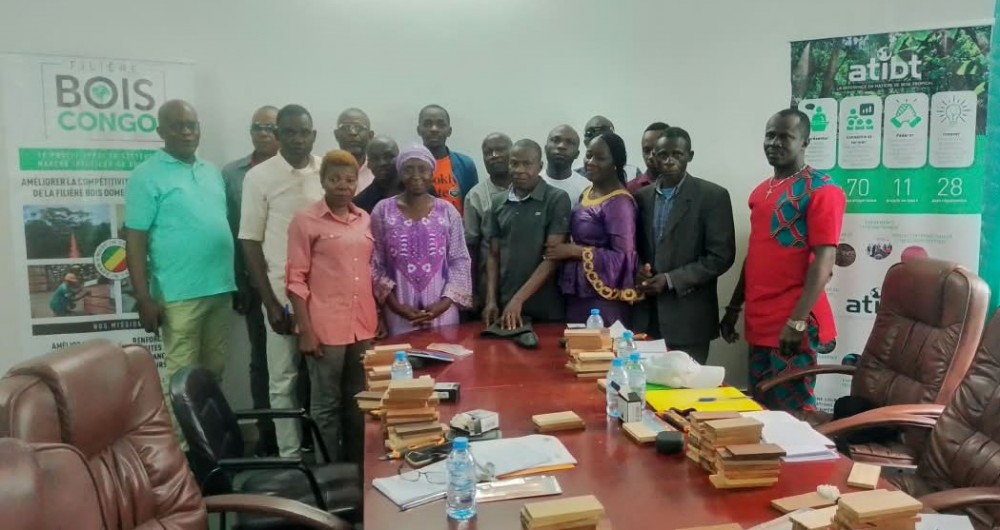
Over the course of five days, fourteen of the sixteen expected participants—most of whom came from professional organizations—took part in a collaborative learning environment, attending lectures followed by hands-on exercises led by trainers and experts in the field. The main topics covered focused on analyzing wood: structure and grain pattern; applying the macroscopic observation method to sawn lumber; and providing a rigorous and practical description of a tree species; the use of identification tools: handbook, species fact sheets, identification key, and reference samples; the identification of species from the selected list on sawn lumber; assessing the reliability of the identification and managing uncertainty.
At the end of the workshop, stakeholders in the domestic timber value chain have expanded their knowledge and now possess the skills to independently recognize the tree species traded on the domestic market, and that the terms “red wood” and “white wood” will gradually be phased out.
It should be noted that the Congolese government has been committed to a process of sustainable forest resource management since 2000, with the publication of Law No. 16-2000 of November 20, 2000, establishing the Forest Code. The Voluntary Partnership Agreement (VPA) with the European Union, ratified on May 17, 2010, aims to improve forest governance in the country and ensure that timber and all its derivative products meet legality requirements. This guarantee is required for both products intended for export and those supplied to the domestic market. However, the domestic market for sawn timber is largely supplied by small-scale artisans using wood from informal and/or “illegal” sources, and thus generates no tax revenue for either the national government or local authorities. Production takes place primarily in the informal sector, which has an impact on forest sustainability. To address this issue, the Ministry of Forestry Economy is focusing its efforts on organizing informal producers in the timber sector. It is in this context that the European Union has funded a project titled “Support for the Private Sector—Domestic Timber Market,” which is being implemented by ATIBT-Congo.
To implement the project, an assessment of the domestic timber value chain was conducted through a study commissioned to the FRMi–BCAF Congo consortium. Following an in-depth analysis, the final report of this study identified several key areas that will guide the project’s next steps. The assessment also identified training and capacity-building needs expressed by stakeholders in the domestic timber value chain, including training in timber identification for those working in the domestic timber sector. In fact, surveys conducted as part of the assessment showed that sellers and carpenters/cabinetmakers have only limited knowledge of wood species. This finding is very important, as it is difficult to envision the diversification of wood species if these key actors in the marketing and processing of sawn timber for the domestic wood market do not acquire knowledge of them. It is in this context that training workshops on the identification and recognition of wood species based on samples are being organized for sawn timber sellers and carpenters and cabinetmakers. After Pointe-Noire, Brazzaville will host this same workshop, followed by Ouesso, the final city to welcome the trainers and the ATIBT Congo team.
Source: www.adiac-congo.com/