Congo/Bouenza: Local Leaders Trained in Project Monitoring and Evaluation
The 2026 edition of the “Carrefour de l’évaluation” was held August 25–26 in Madingou, the capital of the Bouenza Department. This workshop aimed to build the capacity of local stakeholders in the monitoring and evaluation of development policies, programs, and projects.
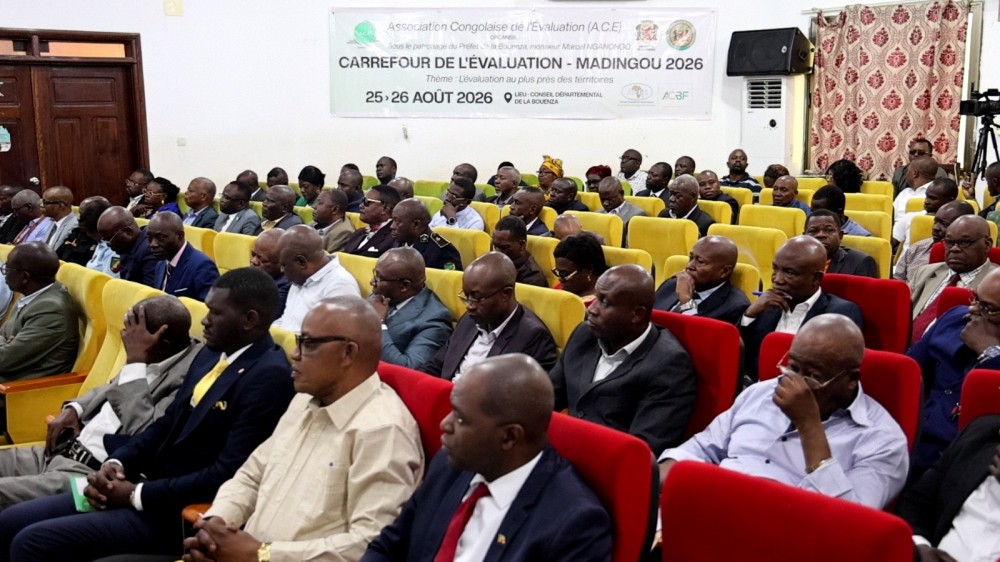
Organized under the theme “Evaluation Close to the Grassroots, ” the meeting brought together government officials, local elected officials, and civil society representatives to discuss monitoring and evaluation tools. The goal was to align evaluation practices with on-the-ground realities. Participants were thus made aware of the importance of monitoring and evaluation in project management. In particular, the goal was to provide them with a common language for monitoring and evaluation, to help them better understand its role in local governments and decentralized administrations, and to introduce them to the implementation of evaluation mechanisms tailored to local realities.
For the organizers—specifically the Congolese Evaluation Association (ACE), the African Capacity Building Foundation, and the Ministry of State Reform and Relations with Parliament—the challenge goes beyond the mere acquisition of technical knowledge. The goal is to make evaluation a genuine decision-making tool, capable of informing decision-makers about the results achieved, the challenges encountered, and the necessary adjustments.
According to ACE President Daniel Mikayoulou, the choice of Madingou reflects a desire to move away from a primarily centralized approach to evaluation. “In the Republic of the Congo, capacity-building and advocacy initiatives related to evaluation are concentrated almost exclusively at the central level, in the capital,” he noted. The relocation of the “Evaluation Forum” to Bouenza represents, in his view, an innovation that is both geographic and methodological. The goal is to equip local stakeholders with the necessary skills to monitor the actions undertaken in their territories and assess their results.
For the prefect of Bouenza, Marcel Nganongo, this approach addresses the need to make evaluation a tool for local governance. “The culture of evaluation must not remain the sole domain of central government agencies. It must take place as close to the ground as possible,” he stated at the opening of the workshop. The prefect believes that strengthening the skills of managers, civil servants, elected officials, and civil society actors can directly contribute to improving the quality of governance and the effectiveness of development initiatives in the department.
In his view, effective public action requires reliable information to measure what was planned, what has been achieved, and what still needs improvement. “There is no good governance without evidence-based data,” he insisted, viewing evaluation as a tool for understanding what works, correcting what needs to be corrected, and better guiding policies and projects for the benefit of the population.
Maintaining Partnerships
At the conclusion of the two-day session, three main recommendations were formulated by the participants and organizers. The first is to continue capacity building through professional development sessions and on-the-ground support. The second recommendation focuses on increasing the participation of women and young, emerging evaluators. Finally, participants advocated for the continuation of the partnership between the Bouenza department, ACE, and technical and financial partners.
Source: adiaccongo