
Switzerland/Brightly Colored Trash Cans to Combat Littering
In Switzerland, long summer evenings often go hand in hand with littering in parks. The IGSU reports that littering is caused by factors such as alcohol, anonymity, and an environment that is already polluted.
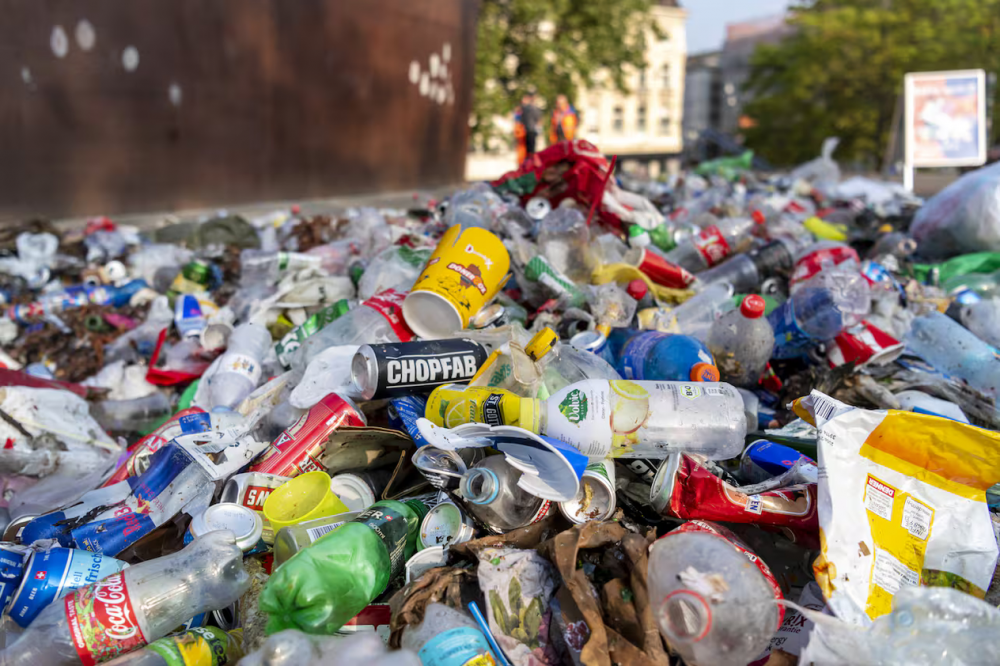
Celebrations during the long summer evenings—whether in parks or elsewhere—often have an unfortunate side effect: littering. The Interest Group for a Clean World (IGSU) provides an overview of the psychological mechanisms behind littering.
What leads people to litter in public places?
There is no single main cause, but rather a combination of various factors. Convenience, a lack of awareness of the problem, habit, indifference, or even a desire to provoke play a role. Context is often a decisive factor: peer pressure, alcohol consumption, darkness, the presence of existing litter, or the absence of social control all encourage this behavior.
To what extent does an environment already littered with trash influence behavior?
The environment clearly has an influence. The presence of litter on the ground signals that littering is common in that area, which encourages further littering. Conversely, a clean environment reinforces the norm of proper waste disposal. Regular cleanup is therefore essential, even if it is impossible to precisely quantify its effect.
Are certain social groups more prone to littering than others?
No, it cannot be attributed to any specific population groups. The context is more important: nightlife, friends, alcohol, a sense of anonymity, and the type of location (for example, picnic areas, the vicinity of takeout establishments, or streets). IGSU therefore focuses its efforts on these high-risk areas rather than on specific age groups.
What types of items are less likely to be perceived as litter?
Misconceptions influence behavior. Cigarette butts, for example, are sometimes considered harmless because of their small size or the mistaken belief that they are biodegradable. The fundamental problem, however, lies in behavior rather than the material itself: a banana peel left in an urban park is no less of a nuisance than a piece of plastic waste.
How do the perpetrators, in their own eyes, justify their behavior?
Through typical rationalizations, such as shifting blame (“There aren’t enough trash cans”), trivialization (“Everyone does it”), downplaying (“There are far worse toxic substances”), or the argument that public cleaning services are funded by taxes anyway.
What are the most effective measures to combat this problem?
Situation-specific incentives, similar to “nudges”—such as arrows pointing to trash cans, humorous slogans, recycling stations, or playful installations—have reduced littering by 31 to 38 percent in various studies. A combination of personal interactions, awareness-raising, and humorous trash cans is the most effective measure. This reduces littering by nearly 50%. The key is to implement a comprehensive set of measures on an ongoing basis rather than one-off actions.
How should trash cans be designed and placed?
They must be clearly visible, easily accessible, convenient to use, and located near where waste is generated. Bright colors and ashtrays placed within six meters encourage their use.
How effective are fines?
They set a clear social boundary, but enforcing them is difficult since the violation must be observed. They are most effective when combined with appropriate infrastructure, awareness campaigns, and “fun” approaches.
Which messages work best: those that make people feel guilty, or those that highlight positive norms?
Positive, humorous, and polite messages yield better results. An experiment conducted at train stations showed that humorous posters (-58%) and those focused on the environment (-64%) reduced littering far more effectively than authoritarian directives.
How can the long-term success of anti-littering measures be measured?
It is virtually impossible to measure the problem comprehensively. IGSU conducts annual surveys on public perception. While in 2015, 25% of respondents considered littering to be “significant” or “somewhat significant,” that proportion dropped to 12.5% in 2025.
Has littering increased over time?
Yes. Increased mobility, the rise of takeout food, and the intensive use of public spaces led to a rise in littering in the late 1990s, and particularly in the 2000s.
Source: www.blick.ch