
Burkina Faso/Agricultural entrepreneurship: From lecture halls to fields in Bagré, students grow onions and other crops
Under Bagré's relentless April sun, between the dust of the road and the pale reflections of the irrigation canals, young agro-entrepreneurs are ploughing their furrows. Boots on their feet for some, hands plunged into piles of freshly harvested onions for others, many of these students have swapped the lecture halls for the fields. They were the first to experiment with an incubation program that attracted many students from the regions in various fields. Their challenge? To make agriculture a path to excellence and contribute in their own way to food self-sufficiency in Burkina Faso.
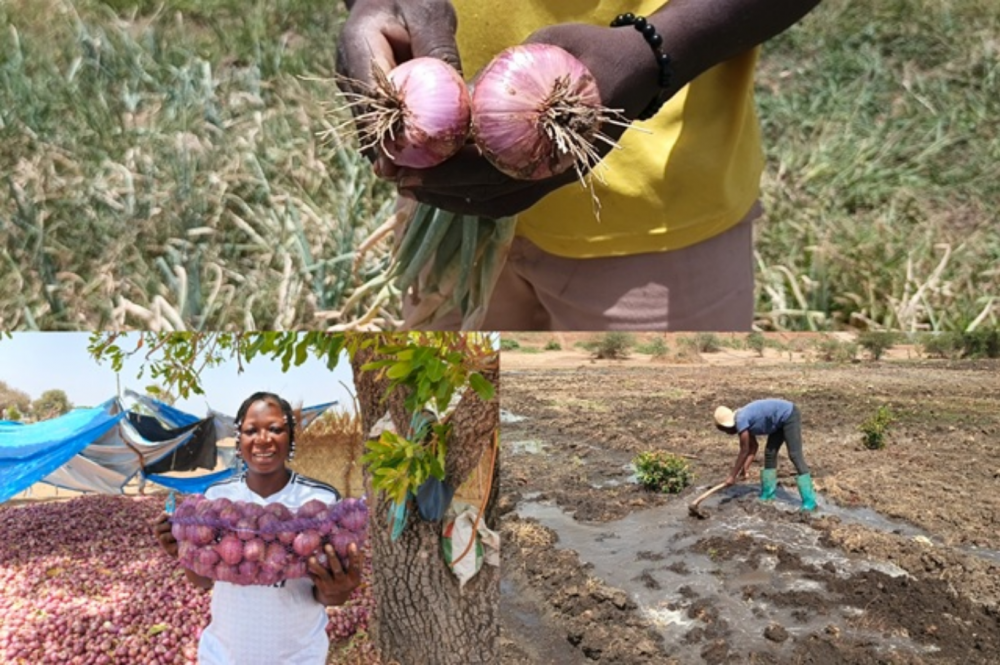
It's just past midday in the depths of the Bagré plain. The heat is dense, almost palpable. It envelops our bodies, seeping into our clothes and clinging to our skin. The hot wind mingles with humidity. On the ground, the soil is dry on the surface but hints at an underground fertility. A few meters away, an irrigation canal unwinds its ribbon of murky water, dividing the plain into two parts.
Water is vital in this productive environment. It is here, in this contrast between aridity and controlled humidity, that many students from public universities are based. Squatting in the middle of a vast carpet of purple onions, Wendinda Fatou Compaoré sorts and aerates her freshly harvested onions. Under her straw hat, her face is marked by effort, but lit up by a proud smile.
Around her, basins, water cans and a few makeshift utensils bear witness to the daily life of a farmer. "When I came here, I knew it wasn't going to be easy. But I didn't think it would be so instructive", she confides, her hands still immersed in the bulbs on the ground. Like her, around forty of them will have joined the incubation program of the Agence nationale de valorisation des résultats de la recherche et des innovations (ANVAR) by 2023. This presidential initiative, organized by the Ministry of Higher Education, Research and Innovation, aims to transform graduates into wealth creators, by setting them up directly on strategic agricultural sites.
A difficult but instructive immersion
Far from the classroom, the Bagré plain imposes its own rules. Here, everything is learned in the field. Soil, climate, water, plant diseases, marketing... nothing is theoretical. "We learned on the job. Even those who had no basis in agriculture were able to get by thanks to the coaching," explains Wendinda Fatou Compaoré, who holds a vocational degree in animal production and health. Balkissa Kafando, who has a degree in plant production and agronomy, also had a good harvest of onions, about 500 meters from her field. "At first, we thought it was going to be complicated. And it is. But it's an experience that transforms you. You learn patience, rigor... and above all humility."
In the fields, the movements are precise, repeated and sometimes exhausting. Ploughing, levelling, staking... physically demanding tasks, even more so for young women. "There are some activities we can't do alone. We're forced to call on other workers. That increases costs," admits Wendinda Fatou. There are also cultural constraints. Certain operations, such as phytosanitary treatments, are forbidden to them. A reality that reminds us that agricultural innovation also comes up against social norms. But far from discouraging them, these obstacles seem to strengthen the determination of the two young girls.
The realities of agribusiness
A few hundred meters away, Wilfried Zongnaba is hard at work in his eggplant field. With his boots firmly planted in the earth, he weeds diligently. His movements are concentrated and technical. "I come from a farming background. But here, I've learned to produce in a different, more scientific way", explains this agronomy student. On a 0.75 hectare plot, he juggles several crops: onions, eggplants and soya. This diversification strategy is essential to limit risk.
But production is not the main challenge, according to the student. "The real problem is selling. Buyers offer very low prices. Sometimes we don't even cover our expenses," he laments. In a corner of the field, under a tree, onions are still waiting to be sold. The paradox is striking: harvests are abundant, but profitability is uncertain. Balkissa Kafando adds that customers come, but they want to fill a 5-kilo bag with more than the normal quantity. "If we accept, we lose. A difficult equation for these young entrepreneurs, who are still financially fragile.
Daniel Zongo, a poultry farming student in Gaoua who has now turned to market gardening, observes the same situation as his fellow students. "We have the land, we produce, but if the prices don't keep up, it's complicated. Sometimes you don't even see the profits" On his 2.75 hectares, he has experimented with several crops. Some succeed, others don't. "Sweet potatoes, for example, didn't work. The soil is too clayey. You have to constantly adapt," he explains. This constant adaptation is at the heart of their apprenticeship at Bagré. Here, farming is not an exact science, but a delicate balance between knowledge, intuition and resilience.
In the middle of Bagré's fields this April, it's the onion crop that's coming into its own. All over the plain, impressive piles of purple bulbs spread out in the open air under the trees. Their slightly pungent scent wafts through the warm air. It's the success story of the season, especially for our incubatees. "In terms of yield, onions are clearly in the lead, along with eggplant and fresh maize", says young Wendinda Fatou. Wilfried Zongnaba also mentions onion yields of up to several tonnes on certain plots.
Why onions? The answer for the incubatees lies in a number of factors, including a suitable growing season, good adaptation to the Bagré soil, gradual mastery of cultivation techniques and a long shelf life. Nevertheless, this production success remains insufficient for these ambitious students. "We produce well, but if we don't sell well, it becomes a problem", insists Wilfried. In spite of everything, this successful campaign has restored their confidence. For Balkissa, it's also a source of personal pride. "When you see the fruits of your labor like this, you kind of forget the difficulties," she says. All around her, a large display of onions symbolizes much more than just a harvest, but also revenge for moments of doubt.
"Those who have been to university...bring a certain innovation to agriculture".
Beyond the fields, these young people carry a vision. A vision of a modern, innovative agriculture, driven by graduates capable of combining academic knowledge and field realities to bring innovation. "I'd just like to say to those who find agriculture demeaning that it's not just for those who didn't go to school. On the contrary, those who have been to university, by being in agriculture, still bring a certain innovation to farming. So, if we leave agriculture in the hands of our parents, who don't have any great ideas for renovating the sector, we'll see that we're not going to make any progress in this area," insists Wendinda Fatou. An important message in a context where the agricultural sector still suffers from a devalued image.
For Wilfried, the future of agriculture also lies in processing. "If we had processing units, we could make better use of our products. For example, processing tomatoes, producing seeds... But to do that, you need the means. Access to financing, equipment, structured markets... There are many needs. We need support and partners. We're ready to work, but we need a helping hand", says the young man. Daniel Zongo, for his part, believes that it is possible to expand, hire and produce, as long as you are sure that it will be profitable.
All these students share the same ambition: to establish themselves on a long-term basis, become role models and inspire other young people. A goal in line with the authorities' vision.
A commitment from the authorities to anchor student agribusiness
Over and above the performance recorded in the field, ANVAR's agricultural incubation project is part of a clear political commitment to the emergence of a new generation of agricultural entrepreneurs. On April 7, 2023, the Minister of Higher Education, Research and Innovation, Prof. Adjima Thiombiano, headed a government delegation to the Bagré growth pole site, togethergation, alongside students, to see first-hand the initial achievements and measure the challenges to be met before the large-scale roll-out of this structuring program.
A few months later, on March 9, 2024, before their graduation, the President of Faso, Captain Ibrahim Traoré, also set foot on the farmland, praising the commitment of the pioneering students. "You are the first, you are the models", he told them, reaffirming the State's support, notably through the provision of boreholes, inputs and seeds. The aim is to turn these young people into role models, capable of training others in their turn, as part of a dynamic of skills multiplication, in order to build a modern, competitive agriculture geared towards food self-sufficiency.
Source: lefaso.net/