
French in Cambodia: between cultural heritage and contemporary challenges
As part of the research project entitled "French language and life trajectory: what future for Cambodian students?", supported by the Agence Universitaire de la Francophonie (AUF), the Institut National de l'Éducation (INE) conducted a study to analyze the impact of French language teaching in Cambodia on students' academic and professional careers.
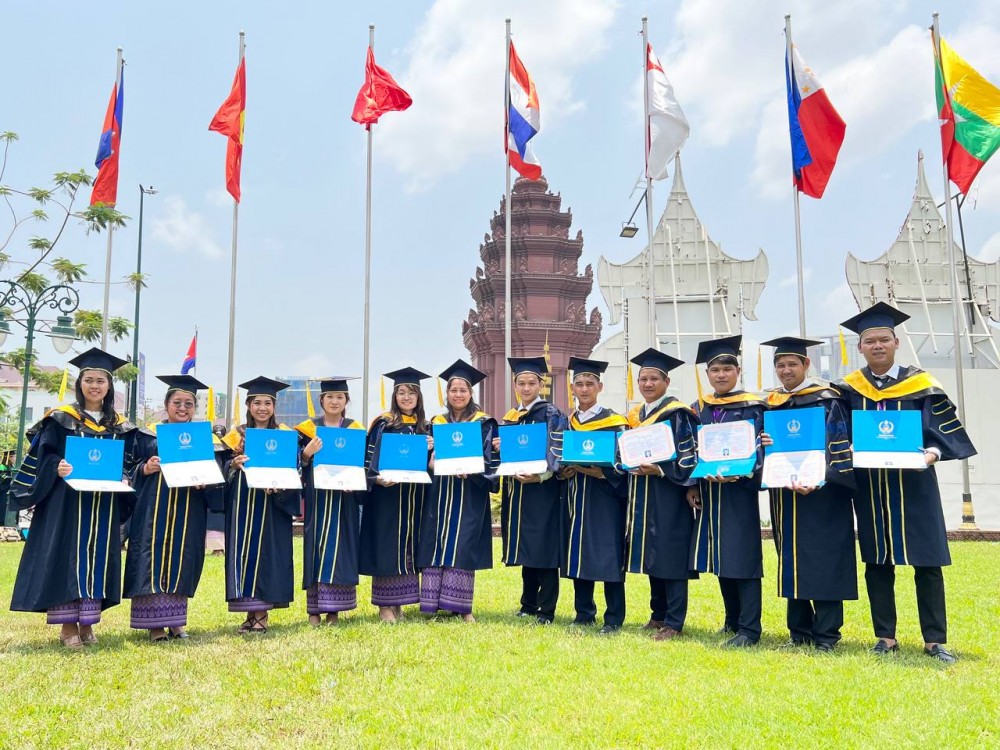
For decades, Cambodia has enjoyed a strong relationship with the French language, thanks to its history and long-standing educational cooperation. The influence of French in Cambodia can be seen not only in its cultural heritage, but also in educational policies that seek to reinforce its learning. However, students often have to choose between their interest in the French language and their career prospects, which are sometimes seen as limited in the face of the growing dominance of English.
The survey carried out by INE involved 14 schools and universities, mobilizing 68 respondents, including students, teachers and school principals, in Phnom Penh as well as in the provinces of Battambang, Siem Reap and Pursat. The testimonies gathered reveal that learners are highly motivated, despite sometimes precarious conditions. However, job opportunities are still limited, and French-speaking careers are often difficult to achieve.
The results show that students who choose French at secondary level often aspire to careers in specific fields such as medicine, pharmacy or diplomacy. Nevertheless, the opportunities offered by the French-speaking world remain limited, both locally and internationally, sometimes restricting career prospects.
While mastery of the French language provides access to scholarships, university exchanges and jobs in certain sectors (tourism, NGOs, teaching), these opportunities remain insufficient to meet growing demand. What's more, many students find it hard to envisage a career in a French-speaking country, for lack of accessible bridges and suitable jobs.
This reality raises the need for an in-depth review of education policies, in line with the concrete needs of Cambodian youth.
Teachers point to major challenges: lack of teaching resources, shortage of teachers, difficulties in accessing in-service training. In the provinces, these obstacles are even more pronounced. Despite this, strong motivation remains, among teachers and learners alike.
This study also underlines the importance of strong institutional support, modernized teaching tools and the promotion of French as a language of opportunity. To ensure its future in Cambodia, it is crucial to strengthen the bridges between study, employment and international cooperation.
The results of the research were widely disseminated to the Ministry of Education, Youth and Sports.ducation, de la Jeunesse et des Sports (MEJS), relevant French-speaking partners, and also French teachers, not only at the Assemblée Géneral Assembly of the Association des Professeurs de Français du Cambodge (APFC) last November, which brought together over 200 French teachers from secondary schools and universities, but also as part of INE training workshops for trainers organized in Cambodia's provinces.
"My hope is that this study will inspire decision-makers, educators and students to continue to work towards a fair and enlightened promotion of the French language in our country", said Mr. Poulin., says INE Director Dr. Sieng Sovanna, adding that "I have always been convinced that the French language plays a role in cultural and professional openness for our country's students.".
The future of French in Cambodia will depend on the ability of institutions to strengthen the attractiveness of this language, through quality training, strategic partnerships and increased support for teachers and students.
As Dr. NY Ratha, Deputy Director of INE, points out, "The results of this research underline the importance of ongoing teacher training, improved teaching resources and the need for constant institutional support. "
An intelligent balance between French and English could offer young Cambodians an enriching trajectory, oriented towards both the French-speaking world and the globalized world.
Committed teachers facing structural challenges
The testimonies of teachers such as Ms Meng Hongsour (Mondol Kiri), Mr Sokchenda Cheng (Kampong Thom) and Ms Dalyvann Chhiet (Battambang) illustrate the difficulties in the field : lack of textbooks, absence of teachers in certain classes, shortage of digital resources, and the perception of French as a difficult language.
In spite of this, teachers remain convinced of the importance of promoting the French language, notably by organizing in-service training, extracurricular activities and exchanges with French-speaking countries.
Since joining the AUF in 2008, INE has been committed to training future secondary school teachers. Its Master d'Enseignement du Français program (since 2019) is part of this drive to professionalize the teaching of French in Cambodia.
Despite the obstacles it faces, the French language continues to attract students keen to distinguish themselves in an increasingly competitive job market. By mastering French, these young people see new professional and academic prospects open up to them. To support this dynamic, the AUF will launch the Programme International de Mobilité et d'Employabilité Fracophone (PIMEF) in the 2025-2026 academic year. an innovative project designed to strengthen the language skills of teachers and students, and to consolidate the importance of French in training courses.
To consult the research project report, click here
-------
Testimonials:
Miss MENG Hongsour, French teacher at Mondol Kiri: "I notice that my students are attentive and assiduous in learning French. There are a few students who don't pay much attention because they think French is a difficult language to learn". She pointed out that there is as yet no modern digital education in this remote province. To improve the teaching of French in the Kingdom of Cambodia, she suggested that the government produce enough basic textbooks to make it easier for French teachers to teach the subject to students.
"I know that in some high schools, the principal doesn't allow them to teach French," said MENG Hongsour, while suggesting that school principals use French teachers to their own specializations and skills.
She added: "In my high school, there is a shortage of French teachers at secondary level. I've taught students in 9thgrade, and when they're in 10th grade, there's no French teacher. So my former students will learn English. These factors make it impossible for students to continue their French studies until 12th grade."
CHENG Sokchenda, French teacher in Kampong ThomCHENG Sokchenda, French teacher in Kampong Thom: "In my opinion, the situation of teaching and learning French in my high school is going quite well, but it still presents some challenges, as there are not always enough books or materials to learn well. Teachers also need more and more training.".
For Professor Sokchenda, French is still present, even if many students choose English. "The number of students in our high school is increasing, and French is becoming more and more important to meet the needs of students who want to become doctors, lawyers, engineers, etc.," he says.It's important to continue to encourage young people to learn French and to receive more support," he added.
In order to improve the teaching of French in Cambodia, I would like to propose several things to the government to organize regular training courses to help teachers improve their level of French and their working methods.
"Schools need books, digital resources, modern exercises and activities to make lessons more lively. We need to create more exchange programs between Cambodian schools and French-speaking establishments, as well as competitions, clubs or activities in French", added Sokchenda, while proposing to organize campaigns or eevents to show young people that French is useful for study, work and travel, and to offer scholarships or internships for students who do well in French to encourage them to continue along the Francophonie path.
Miss Dalyvann Chhiet, French teacher at Lycée Preah Monivong, Battambang: "Personally, I find that the best students want to continue their studies from and in French right through to high school for the time being because they're convinced that French is interesting. On the other hand, the less strong don't want to learn it because of the difficulty of understanding, especially grammar, which is more complicated compared to our mother tongue and English. "
Source: www.auf.org/