Burkina Faso: Plan International evaluates and reinforces its strategy for sustainable impact in the Centre-East and East regions
Plan International Burkina Faso held its annual review of projects and programs on Thursday, July 25, 2024, in Koupela, in the Centre-Est region. The workshop was precisely part of its annual review of the 2019-2023 Country Strategy, extended to December 31, 2024. The event, chaired by the governor of the Centre-Est region, was presided over by his representative, Constantin Dabiré, high commissioner of the Boulgou province. It was also attended by Mahomet Ouédraogo, Director of Plan International's Centre-East and East Region Office, and Silas Nacanabo, High Commissioner of Gourma Province.
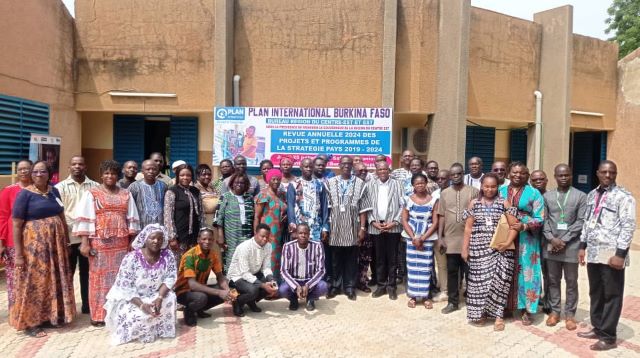
The main objective of the annual review of the 2019-2023 Country Strategy (running until December 31, 2024), of Plan International's Central East and East Region Office, is to assess the progress of projects and programs. It also aims to draw lessons to improve implementation of the annual plan for fiscal year 2025.
It should be noted that Plan International Burkina Faso's country strategy for the current fiscal year is based mainly on three strategic axes. The first concerns sexual and reproductive health, and the fight against gender-based violence (GBV). The second focuses on decent jobs and entrepreneurial opportunities for young people and women. The third axis is based on quality and inclusive education, early childhood development and child protection.
"Plan International Burkina Faso has developed a country strategy adopted in 2019 and aligned with the global strategic vision at the level of the international organization. This has enabled us to strengthen our actions based on gender programming and influence. This strategy will enable 200 million vulnerable and excluded girls around the world, including two and a half million in Burkina Faso, to learn, lead, decide and thrive," emphasized Mahomet Ouédraogo.
The aim of extending this strategy is to improve the quality of Plan International's interventions, by integrating crucial programmatic aspects. To this end, participants carried out an assessment of current projects. The assessment covered both the physical and financial aspects of the projects, providing a comprehensive picture of their implementation. This analysis revealed the successes achieved as well as the challenges encountered.
Nearly 11,000 children sponsored
According to Sien Hien, sponsorship coordinator at Plan International's Centre-Est et de l'Est office, 10,922 children, including 7,584 girls and 3,338 boys, have been sponsored in the province of Kouritenga (Centre-Est region). According to Sien Hien, this represents 30% of the number of children sponsored nationwide. He explained that sponsorship consists in creating a one-to-one relationship between a child and an individual sponsor or group of sponsors. This, Mr. Hien added, makes it possible to mobilize funds for the implementation of projects and programs in the sponsored areas.
The sponsorship coordinator confides that seventeen seriously ill children have also been cared for. "Four of the most serious cases have been referred to specialized health centers in Ouagadougou. There are currently two children still undergoing treatment", he declared.
Inclusive education
In terms of inclusive and quality education, the following results were achieved. Paul Doygbé, Program Manager at Plan International's Centre-East and East Office, stated that fourteen semi-finished and equipped classrooms have been built in five schools, benefiting 1,639 pupils, including 816 girls. The number of internally displaced pupils (IDPs) reached out of the total number of beneficiaries is 884. These projects, he says, were carried out in the communes of Bittou, Koupéla, Fada N'Gourma, Gounghin and Pouytenga. In addition, nine classrooms have been rehabilitated and equipped in two schools in the communes of Koupéla and Bittou, benefiting 480 pupils, including 238 girls. The number of EDI represents 424 pupils.
Mr. Doygbé also highlighted the construction of two boreholes equipped with human-powered pumps (PMH) in the schools of sectorcoles in sector 2C of Fada N'Gourma and Bittou, benefiting 808 pupils, including 452 girls, with 467 EDI reached. "We carried out ten awareness-raising sessions on menstrual hygiene management (MHM) in ten schools, for the benefit of parents and local authorities. This is an aspect that Plan International is focusing on to enable girls to follow their studies properly. Four blocks of GHM latrines have also been built at Boangtenga elementary school and Collège d'Enseignement Général (CEG)," he said.
The program manager at Plan International's Centre-East and East Office also noted the payment of school fees for 1,430 pupils, including 748 girls, 700 EDI and 27 disabled pupils. In addition, 2,817 school kits were distributed to pupils, including 1,487 girls and 2,065 EDI. 3,273 girls and women, including 2,752 IDPs, received GHM kits. 95 teachers, educational supervisors and partners attended two training sessions on GHM in schools. 27 schools benefited from 718 GHM kits and materials for making reusable sanitary towels.
Entrepreneurship and employability
In the area of youth entrepreneurship and employability, with a view to promoting the economic empowerment of women and young people through financial inclusion, Plan International Burkina has set up 64 VSL (Village Savings Loans) groups, including 15 youth groups with 1,288 members made up of 1,100 women. Nine communal savings and credit group network offices have been renewed. The sum of 662,385,780 CFA francs in savings was mobilized, with credit granted to the value of 271,524,250 CFA francs. A provincial fair for savings and credit groups was held.
In addition, 96 village agents, including 77 women, were trained in the savings and credit group approach. 100 women members of savings groups have been trained in small ruminant breeding, and 70 of them have been provided with breeding nuclei for brood-rearing (two females and one male). Other results include training in liquid soap production for 30 women members of savings groups. In addition, 17,951 members of 792 savings and credit groups were sensitized to the themes of health, children's rights and financial inclusion.
With a view to facilitating young people's access to economic opportunities, two young girls who are members of savings groups received support to pay the costs of their advanced training courses, and benefited from cutting and sewing installation kits.
Sexual and reproductive health
In terms of sexual and reproductive health rights, four awareness-raising sessions on sex education were held in primary and post-primary schools, benefiting 162 participants, including 98 girls. 86 young people, including 81 girls, were trained in the manufacture of GHM kits and equipped with life skills. 82 pupils, including 53 girls, were made aware of sexual and reproductive health and rights (SRHR) services. In addition, 27 groups of future husbands were set up in nine communes of the Centre-Est and Est regions.
On the subject of marriage, early and forced unions of children, and female genital mutilation (FGM), 117 religious/community leaders and parent-teacher associations were trained in child marriage and FGM. A training course on child marriage and FGM was organized for nine women. Six advocacy workshops were held in favor of abandoning early marriage and FGM, and promoting gender equality.
Early childhood development and protection against violence
Achievements in early childhood development and protection against violence were also presented. "Foodstuffs and cooking demonstration equipment to the value of 6,800,000 CFA francs were distributed to Social Promotion Health Centers (CSPS). 584 GASPA (Groupes d'apprentissage et de suivi des pratiques) training sessions were carried out in the field of Infant and Young Child Feeding (ANJE). Two days of excellence were facilitated in the Koupéla and Pouytenga health districts", reported Paul Doygbé.
A total of 8,188 people, including 3,357 women and 3,302 girls, were sensitized on gender-based violence (GBV), gender equality and inclusion, and child protection. 45 children, including 43 vulnerable girls and victims of violence, received food and health care. Seventeen clubs, including seven positive masculinity clubs, and ten clubs to combat GBV were set up in the province of Kouritenga. The Day of the African Child was celebrated on June 16, 2024 in Tenkodogo, etc.
Physical and financial results estimated at around 94%.
The cost of implementing all the projects carried out in the East region came to 319,134,168 CFA francs, with planning of 105,487,163 CFA francs, and a consumption rate of 84% at the end of the fiscal year. end of the fiscal year on June 30, 2024, according to Evrard Paré, monitoring and evaluation coordinator for Plan International's Centre-Est et de l'Est office. "For the Centre-Est budget, we have a rate of 97%, with planning of 724,774,629 CFA francs. We are at 1,043,908,797 CFA francs of the planned budget, with an execution rate of 93% at the end of the fiscal year on June 30, 2024. We have a physical balance sheet with a percentage of execution roughly equal to the financial balance sheet, estimated at around 94%," he detailed.
Evrard Paré points out that, of the fourteen projects carried out, several have reached the same beneficiaries through the activities carried out. These people were then counted once and only once. "If all fourteen projects reach a single child through fourteen activities, we count a single beneficiary to avoid duplication," he explains.
Mr. Paré recorded 24,019 direct beneficiaries and 17,680 indirect beneficiaries in the field of education, 29,913 direct beneficiaries andand 61,984 indirect beneficiaries for the health sector, and 5,507 direct beneficiaries and 36,202 indirect beneficiaries for the entrepreneurship sector.
Difficulties encountered
The difficulties encountered throughout the implementation of the projects are the inaccessibility of certain intervention zones in view of the security crisis, confided Mr. Paré. He also highlighted the failure to meet contractual commitments, particularly in terms of agreements signed with implementing partners. Added to this is the drastic reduction in the sponsorship budget, resulting in the suspension of the enrolment of new children for this purpose.
"The difficulty we are also encountering is at the level of the technical services concerning the agents identified to participate in our various activities and those on whom we mainly rely to deploy the package of activities of certain projects. Every year, we are faced with a perpetual restart, because new assignments are made all the time. We also have to deal with the fact that certain local associations have not signed contracts for the implementation of our projects. Following the audit of Plan International's head office, some associations were singled out and blacklisted. The associations concerned exist in all our intervention regions", said Evrard Paré.
The annual review of the 2019-2023 country strategy concluded with the development of a plan to implement the recommendations. Participants put forward concrete proposals to improve project quality and efficiency. This action plan will be closely monitored to ensure that recommendations are implemented and that projects continue to meet beneficiaries' expectations. The Koupéla workshop was therefore a crucial step in the evaluation and continuous improvement of Plan International Burkina Faso projects. Participants underlined the importance of collaboration and participation by all stakeholders to ensure quality interventions for young people, women and children in the country of men of integrity.
- Source: lefaso.net