Morocco/Meknes: INDH's commitment to cooperatives bears fruit
In a capitalist world dominated by greed and cut-throat commercial competition, cooperatives have emerged as an ingenious and stubborn alternative to the domination of multinationals on world markets.
With the aim of sharing wealth equitably and democratically, cooperatives offer an attractive formula for small craftsmen, farmers and other traders who, thanks to their inclusive approach, can offer quality products on a more controlled scale.
With a view to promoting sustainable and inclusive development, the National Initiative for Human Development (INDH) was quick to recognize the potential of this business model in Morocco.In recent years, their number and performance have grown exponentially.
In the Meknes prefecture, INDH has deployed major resources to support all types of cooperatives, which play a crucial role in helping artisans and farmers structure their income-generating activities and improve their financial and social situation.
Between 2019 and 2023, some 67 cooperatives benefited from INDH support in the Meknes prefecture as part of its Phase 3, at a total cost of over 13 million dirhams (MDH), including an 8.5 MDH contribution from the INDH.Initiative in favor of 376 beneficiaries, Hamid Chiadmi, head of the INDH's youth income and economic inclusion program at the Meknes prefecture, told MAP.
INDH's support doesn't stop there. As Mr. Chiadmi explained Chiadmi on the occasion of the celebration of the International Day of Cooperatives (first Saturday in July each year), these cooperatives also benefit from training in the skills and knowledge of the INDH.As Mr Chiadmi explained on the occasion of International Cooperative Day (the first Saturday in July each year), these cooperatives also benefit from training in accounting and marketing, as well as monitoring and evaluation by consultancy firms.
A shining example of the success of INDH's action to promote the social and solidarity economy is the "Lembarkia" agricultural cooperative, which specializes in beekeeping and the production and marketing of honey.
Located in Aïn Orma, some twenty kilometers from Meknes, this small cooperative was founded in 2012 and benefited from INDH support in 2019.
"We received support of 190.000 Dh from the INDH, representing a 70% contribution to the financing of the cooperative's project, which was then able to obtain certifications from theOffice National de Sécurité Sanitaire des Produits Alimentaires", Arif Arkaz, president of the "Lembarkia" cooperative, told MAP.
With a staff of nine, including five women, this cooperative specializes in the production of several types of honey, including flower honey and thistle honey from the Middle Atlas.
"Thanks to INDH support, we can produce between 8 and 10 kg of honey per hive for flower honey. With around 160 hives, this means a production of 1.6 tons for this variety alone", explained Mr. Arkaz.
He added that the honey is sold at various fairs for prices ranging from 120 dh to 250 kg, depending on the variety.
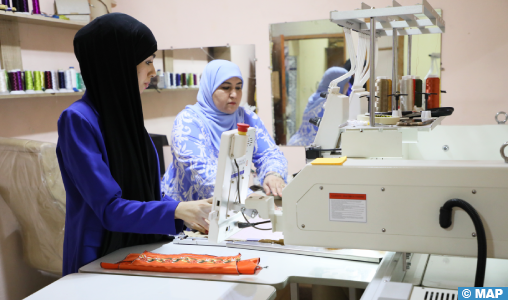
Another example of INDH's all-out action: the "Afak Linnajah Wa Al Moustakbal" cooperative, located in the Nassim district of Meknes and dedicated to traditional sewing and embroidery, also bears witness to the Initiative's sustained efforts to empower women.
"Initially, we were five women who decided to found the cooperative in 2023. We soon obtained support from INDH, which enabled us to acquire new embroidery equipment and machines," the cooperative's president, Hassana Oussaid, told MAP.
"The impact of this aid was instantaneous. Previously, it took us over a month to complete one piece. Now, we can produce several pieces a day", she said, noting that INDH had contributed 60% of the project's funding, i.e. a total of Dh190,000.
The cooperative's new equipment has enabled it to become practically a training center for many women, who take refuge there to learn the traditional art of Moroccan embroidery.
The caftans, djellabas and other traditional tablecloths produced by the cooperative are then sold at fairs and shows. The cooperative also takes orders from private individuals, helped by the growing number of members, says Ms. Oussaid.
The "Lembarkia" and "Afak" cooperatives are eloquent examples of the success of INDH's approach to promoting the social and economic development of the region.The "Lembarkia" and "Afak" cooperatives are eloquent examples of the success of the INDH's approach to promoting the social and solidarity economy, making cooperatives levers for sustainable economic growth and an effective means of combating poverty.
Source: www.mapexpress.ma/