
Cameroon/Road rehabilitation: Cameroon experiments with a technique from the United States to cut costs
As part of the project to rehabilitate the 115 km road between the towns of Mbalmayo and Sangmélima, in the Centre and South regions respectively, the Cameroon government is experimenting for the first time with the technique known as Emulsion Enhanced Recycling (EER). "The technique involves reusing tired in-place material and improving its performance by recycling it... The result is an in-place material that can withstand traffic for ten to fifteen years," explains Simo, technical director of the project at Razel.
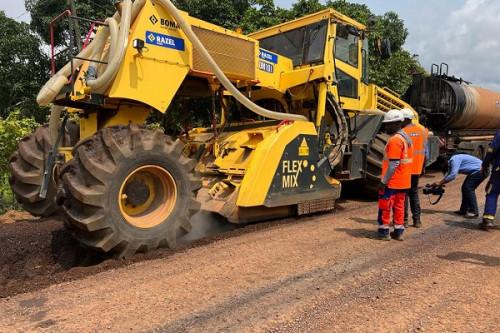
Developed in the United States, the technique is already in use in Europe, Morocco, Côte d'Ivoire, Kenya, Mali and Ghana. It is expected to reduce road rehabilitation costs in the country. "Pavement recycling projects are less costly than conventional approaches," says the Ministry of Public Works. In fact, recycling enables savings to be made on the following items: site facilities (the limited quantities of quarry materials brought in reduce the need for crushing plants)opening of new quarries; transport of materials to be deposited or aggregates to be supplied; execution time.
To facilitate the execution of these works, the project has been divided into three lots. To date, 3.2% of work on lot 1, entrusted to Routd'Af for a budget of some 7.7 billion FCFA, has been completed. On lot 2, financed to the tune of 7.5 billion FCFA, Arab Contractors is at 7%. On the third lot, entrusted to Razel for nearly 5.103 billion FCFA, the execution rate is 3.59%. In total, the State is therefore expected to spend 20.3 billion FCFA to rehabilitate the 115 km of road, i.e. an average of 176 million FCFA per km of road.
For several years now, Cameroon has had the reputation of having some of the most expensive roads in Africa. In 2013, during a meeting of the focal points of the National Road Council (Conaroute), it was revealed that the average price per kilometer of paved road in Cameroon is estimated at around 205 million FCFA, compared with an African average of 100 million FCFA. In a report published in 2018, the World Bank revealed that certain road infrastructures in Cameroon are 2 to 6 times more expensive than African projects of the same scale.
Source: www.investiraucameroun.com