
Côte d'Ivoire/Mining: When manganese boosts local development (Report)
Mining activity in Lauzoua, around 147 km from Abidjan, is a boon for this sub-prefecture of the Guitry department (Lô-Djiboua region).
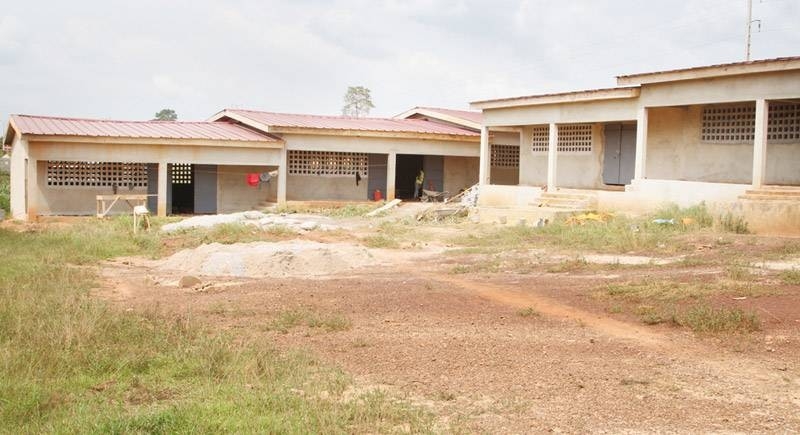
Since manganese mining began in this locality, whose soil contains some 3.2 million tonnes of the mineral, the population has benefited from drinking water, schools, maternity wards and passable roads...infrastructures that boost local development.
It's 1pm in Dougodou, a village 5km from Lauzoua, under a blazing sun. This doesn't deter Ahou Martine and her sister Adjo Valérie from their daily chore of collecting drinking water. Balancing a basin on their heads, the two young women hurry towards a house belonging to Sidibé Mohamed, a 50-year-old whose home is particularly popular.
The reason: this is the site of the village's only hydraulic pump, built in 2020 by the Compagnie minière du littoral, which operates the manganese mine. For 47 years, long before the Chinese company moved in, the 2,000 inhabitants of Dougodou, a village created in 1972, had only their river as a source of water.
Sidibé Mohamed remembers this difficult period: "Before, the women used to fetch water from the river. It was very painful. But now, thanks to this pump, they no longer have to walk for miles to get the precious liquid. He praises the quality of the pump water, which has nothing to do with that of the river, home to microbes and a source of disease.
Ahou Martine, one of the two young women, corroborates the words of the "guardian" of the vital water source: "This pump has considerably improved our daily life in this village. It's a real relief and we're delighted".
A school and maternity hospital for the local population
In addition to the pump, the mining company has also donated an elementary school to the people of Dougodou, as part of its social initiatives, particularly in the area of Corporate Social Responsibility (CSR).
Built on a one-hectare site, the school has six classrooms, several staff offices and eight toilets. "This school solves a real problem in this village. Before, in the school built by the villagers, the children sat four to a table. Teachers had to work with overcrowded classrooms. But today, with the new school, things have changed," says a delighted Yoman Elisée, a teacher.
As for Koffi Bernard, a planter, he intends to re-enroll his son. "I had withdrawn my child from school because of the poor study conditions. But today, with the construction of this new establishment, my son will be back in class", he declares, very happy.
A maternity hospital, already under construction, will be added to the pump and the school, to the great delight of these populations who lacked everything. The health facility will enable the village's women to give birth in good conditions.
At least, that's what Kouassi Akissi Claudine is hoping for, as she admits to having experienced a lot of hardship during her last delivery: "I've had some difficult deliveries. For lack of a maternity hospital, I was evacuated to Grand-Lahou for my last three deliveries", she recalls; while hoping that, once completed, the infrastructure will put an end to, or at least reduce, the number of women dying in childbirth.
She welcomes the presence in the locality of this mining company, which brings a smile to the faces of the local population, thanks to its social actions.
Rural tracks rehabilitated to facilitate the evacuation of agricultural produce
Access to the plantations was a real ordeal for producers. The bumpy tracks, especially in the rainy season, made it very difficult to evacuate agricultural produce.
Paul Kroko, central president of the Jeunesse de Dougodou and storekeeper at the Lauzoua mine, is delighted that the roads are now in good condition.
"Neighboring villages used to have great difficulty selling their produce. But those days are over, because the Lauzoua road, like many others, has been reprofiled. It was difficult for palm oil and rubber producers to sell their products. The roads linking neighboring villages, from Agnikro to Lozoua-carrefour, and from Zorokro to Dougodou, have been restored to good condition," he says.
The village youth leader calls for these actions to be extended to other localities, to enable agricultural produce to be sold more efficiently. This, he says, will benefit both buyers, who find it difficult to access production areas, and farmers, who spend a lot of money transporting their crops.
100 million investment in the Mining Local Development Committee
The mining company's actions are in line with the Mining Code resulting from Law No. 2014-138 of March 24, 2014. Created under this Code, the Comité de développement local minier (Cdlm) must receive 0.5% of its sales from the mine; at the end of its financial years. It is chaired by the regional prefect.
The company in charge of the mine, 51% of whose capital is held by the Société pour le Développement minier de la Côte d'Ivoire (Sodemi), 10% by the State and 10% by the State and 39% by the China Geological Mining Corporation (Cgm), invests 100 million FCFA per year in the Comité de développement local minier (Cdlm).
In addition, it undertakes social actions through the maintenance of tracks, and the construction of schools and health facilities in the region.
The main role of the Cdlm is to contribute to the economic and social development of localities affected by mining operations. In other words, the Comité de développement local minier brings local development to populations deprived of their land or impacted by mining activity, and creates more decent living conditions for them.
..........................................................................................
- Providing employment for the rural community
Around 100 permanent and 250 temporary employees, including around 100 women, are currently working there. The Lauzoua mine offers real job opportunities for young men and women from the surrounding villages, notably Dougodou, Zorokro and others.
Untrained women are also regularly recruited and trained to sort the ore. One of their supervisors explains their work: "The task assigned to these women is to remove as many impurities as possible. We have trained them to do this. Manual sorting removes impurities such as laterites and pebbles, to make the ore cleaner and increase its grade".
According to the manager, the women are trained for three months in manual sorting, the time needed to teach them to distinguish manganese from the impurities that have crept in. "They work from 7am to 3pm. The mining company recruits these women, currently around ten, to help their families.
Source: www.fratmat.info