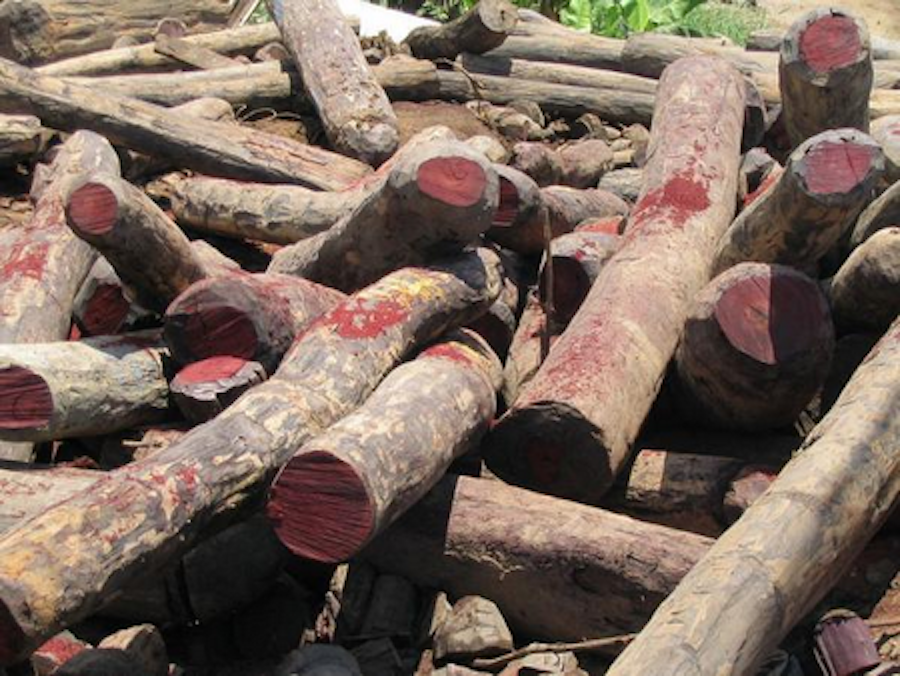
Mali/2nd edition of the sustainable development days: 400 000 ha of forest destroyed per year because of logging
The International Center for Consulting and Training (CICF), in partnership with the Malian Agency for Renewable Energies (AER), organized the second edition of the Sustainable Development Days. These days are intended to be an annual meeting to discuss major issues on sustainable development. Theme: "The challenges of the Energy Transition for Mali". The first day was devoted to the demonstration of solar equipment at the Regional Center for Solar Energy (CRES) and the second was held at the Onomo Hotel in the form of panel discussions.
The opening ceremony of these two days of exchange was chaired by Moussa Ombotimbé, representative of the Minister of Mines, Energy and Water. It was attended by Mossadeck Bally, President of the National Council of Employers of Mali (CNPM), Ms. Bengaly Minian Berthé, Director General of the International Center for Consulting and Training (CICF), Souleymane BerthéSouleymane Berthé, Director General of the Agency for Renewable Energies (AER), representatives of ministerial departments, diplomatic representations, industrialists, economic operators and financial institutions. According to Souleymane Berthé, Director General of the Renewable Energy Agency (AER), renewable energies are real means of adaptation to climate change, especially solar thermal technologies, namely solar cookers, solar water heaters and dryers." The use of this equipment on a large scale not only to meet our energy needs, but also to exploit our potential for renewable energy, especially solar and wind. nergy especially solar and avoid millions of tons of CO2 and other harmful gases, because these equipments are zero CO2 whose running on clean energy, "he said.
As an example, the Director General of the AER spoke of the use of solar cookers and solar water heaters that will greatly reduce the cutting of wood, because today, in our energy balance, wood is the main source of energy.Today, in our energy balance, wood energy occupies more than 75% and it is more than 400 000 ha of forest destroyed per year." The usefulness of this equipment is obvious. They are designed and developed by Malian researchers and most of the components are local materials or available on the local market. Today, we think that the technology of these equipments is mature and it is time to make them leave our workshops and laboratory for a wide popularization and for the happiness of the Malian population", said Souleymane Berthé. He recalled that the AER is a public institution of scientific and technological nature with legal personality and financial autonomy, whose main mission is the development of the scientific and technological knowledge of the country.He recalled that the AER is a public scientific and technological institution with legal personality and financial autonomy, whose main mission is the large-scale use of their potential for renewable energy and assess the potential of the country in renewable energy.
Speaking about the theme, Ms. Bengaly Minian Berthé, Director General of the International Center for Consulting and Training (CICF) said that its choice is not insignificant, because Mali, through its determined contribution at the national level, has through its nationally determined contribution, has committed to reducing greenhouse gas emissions by 31% for energy. She pointed out that the achievement of this goal does not depend only on the actions of the government, companies, households and citizens, all have the opportunity to act. "The weight of the consumption of companies is enormous; they can have the opportunity to move towards mixed energy to reduce their carbon footprint, save money and promote companies operating in the renewable energy sector. As for households, from the use of household appliances to the use of stoves, they can have alternatives that will allow them to participate in sustainable development, to reduce their energy consumption and to improve their energy efficiency.As for households, from the use of household appliances to the use of stoves, they can have alternatives that will allow them to participate in sustainable development, reduce their energy costs, clean up their locality and reduce the risks of unavailability of energy sources," she said. She added that the world reserves of fossil fuels are depleting at an alarming rate and that if we continue in our current consumption pattern, oil will be exhausted in 40 years, gas in 70 years and coal in 250 years." Beyond the depletion of reserves, fossil fuels are also sources of pollution.Beyond the depletion of reserves, fossil fuels are huge sources of pollution, which is harmful to our environment, our planet and our health," said the director general of CICF.
For his part, the boss of the bosses of Mali, namely Mossadeck Bally, mentioned that companies and investors must also be strongly involved, because it represents the key engine of economic growth in the developing country as another accounting for 60% of GDP 80% of capital flows and 90% of jobs. Regarding the theme of this year, he stresses that it is not fortuitous at a time when the most developed countries are facing an unprecedented energy crisis and are struggling to ensure dominance and energy security.
The representative of the Minister of Mines, Energy and Water, Moussa Ombotimbé, said that the objective of these days is to promote the commitment of the Malian government, public and private sector actors in favor of investment in energy and renewable energy actors in Mali." It is also a way to realize and exploit the potential of natural resources in Mali, consider a climate adaptation plan to the needs of users and promote investment in technological innovation Malian. As you know, the importance of renewable energies, especially solar machines is no longer to be demonstrated and their contribution to sustainable development and our planet makes it, the most coveted energy nowadays", he argued.
To conclude, the technical adviser reported on the applications of renewable energy that will fight against poverty, climate change and improve the living conditions of people especially in rural areas. They will also contribute to the expectation of universal access to electricity by 2030 or 2040, a guarantee of any socio-economic development of our societies.
Source: maliactu.net