
DRC/Local Development Program-145 Territories: Bwala-Yulu in Masi-Manimba territory electrified by ANSER
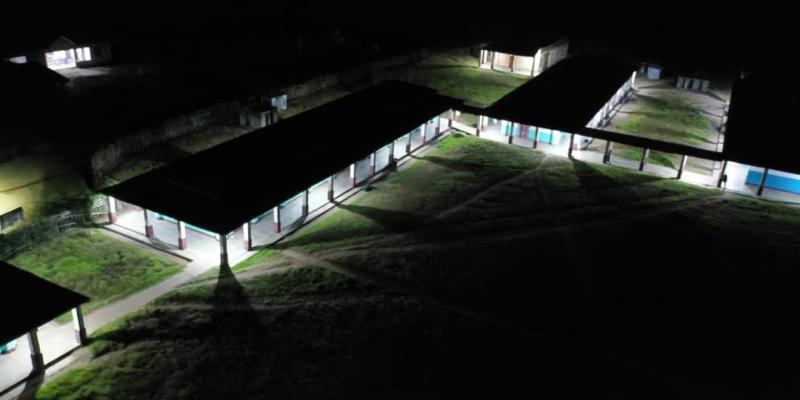
For one month on the ground in the Mokamo sector, Masi-Manimba territory (Kwilu province), ANSER has just finalized the electrification of three high-density localities: the rural commune of Bwala Yulu, the Catholic mission of Yasa and its outbuildings, as well as the general reference hospital of Bonga Yasa and its surroundings.
This project, like the one recently completed in Ipamu in Idiofa, is in line with the logic of rapid electrification at lower cost that ANSER is experimenting with in the electricity access component of the Local Development Program for 145 territories promoted by the President of the Republic, His Excellency Felix-Antoine Tshisekedi.ANSER is experimenting with the access to electricity component of the Local Development Program for 145 territories promoted by the President of the Republic, His Excellency Felix-Antoine Tshisekedi.
In Yasa, access to electricity coincides with the celebration of the centenary of the presence of the Sisters of Charity of Namur in the heart of this Catholic mission. In the rural commune of Bwala Yulu, home to more than 20.In the rural commune of Bwala Yulu, home to more than 20,000 Congolese, it is the first time that electricity has been used and the reference hospital of Bonga Yasa, with its 265 beds, is once again able to function with all its medical equipment. This means that a new era marked by access to electricity is coming with new possibilities for the craft industry.This means that a new era marked by access to electricity is about to begin, with unprecedented possibilities for local crafts, commerce, hospitals, local administration and educational institutions.
Efficient use of solar energy for sustainable access to electricity
Using energy operators, in accordance with national procurement mechanisms, ANSER has coordinated the sizing and installation of solar photovoltaic plants with a total capacity ofwith a total capacity of 130 kWp distributed over the three localities at the rate of 55 kWp for the mission of Yasa, 40 kWp for the hospital of Bonga-Yasa and 35 kWp for the rural commune of Bwala-Yulu. In addition to one hundred lamp posts along the main roads, a total of 7 pico power plants have been installed throughout the region. The energy produced by the various solar power plants now supplies academic institutions (ITM and ISTM, primary and secondary schools and boarding schools), administrative buildings, hospitals and more.The energy produced by the various solar power plants now supplies academic institutions (ITM and ISTM, primary and secondary schools and boarding schools), administrative buildings, hospitals and, more particularly, local crafts, and water supply pumps from boreholes and springs located several kilometers from the city.
Here, the surprise is great for more than one who did not imagine the solar energy to be able to make turn a General Hospital of Reference with its incubators in neonatal incubators, radiology machinery, sterilization equipment and respiratory assistance equipment, all without pollution or the hum of motors. Everything runs in a very environmentally friendly way.
Economic potential released through access to energy
It is worth noting that the Masi-Manimba region benefited a few years ago from a fish farming development program financed by USAID. Consequently, in addition to the traditional cultivation of maize and cassava which proliferate there, fish production is abundant and faces the challenge of production conservation. The mills that have been installed so far have relieved the burden on households used to pounding cassava and corn for daily consumption.The mills installed, which have so far relieved households used to pounding cassava and corn for daily consumption, will now enable farmers to add value to their production, thanks to their capacity to grind the equivalent of more than 5 tons per day. With regard to fish farming, the availability of electrical energy paves the way for the installation of cold chains for the conservation of fish and the production of ice scales. Restaurants, hairdressing salons, sewing workshops are also concerned by this mini solar network set up by ANSER. In addition to this, solar pumps for drinking water supply.
The"market approach" to access to electricity, a cost at the end of each connection
Throughout the region, the euphoria caused by the access of more than 600 households to electricity was quickly followed by the question of the sustainability of the works. This concern underlines the anxiety of a return to the initial chaos marked by darkness in case of lack of maintenance and upkeep of the built works.
ANSER has anticipated this issue by planning, through a memorandum of understanding currently under discussion with CENCO, which has long supported the development of the region, to set up a local operator to manage the access to the road.This will generate enough resources to ensure the sustainability of the project. This will generate sufficient resources to ensure the maintenance and sustainability of the facilities.
In the rural commune of Bwala-Yulu, in the mission of Yasa as well as in Bonga-Yasa, the dividends of the electrification component of the Local Development Program - 145 territories are palpable and the anticipated structural changes are being verified.
Source: actualite.cd/